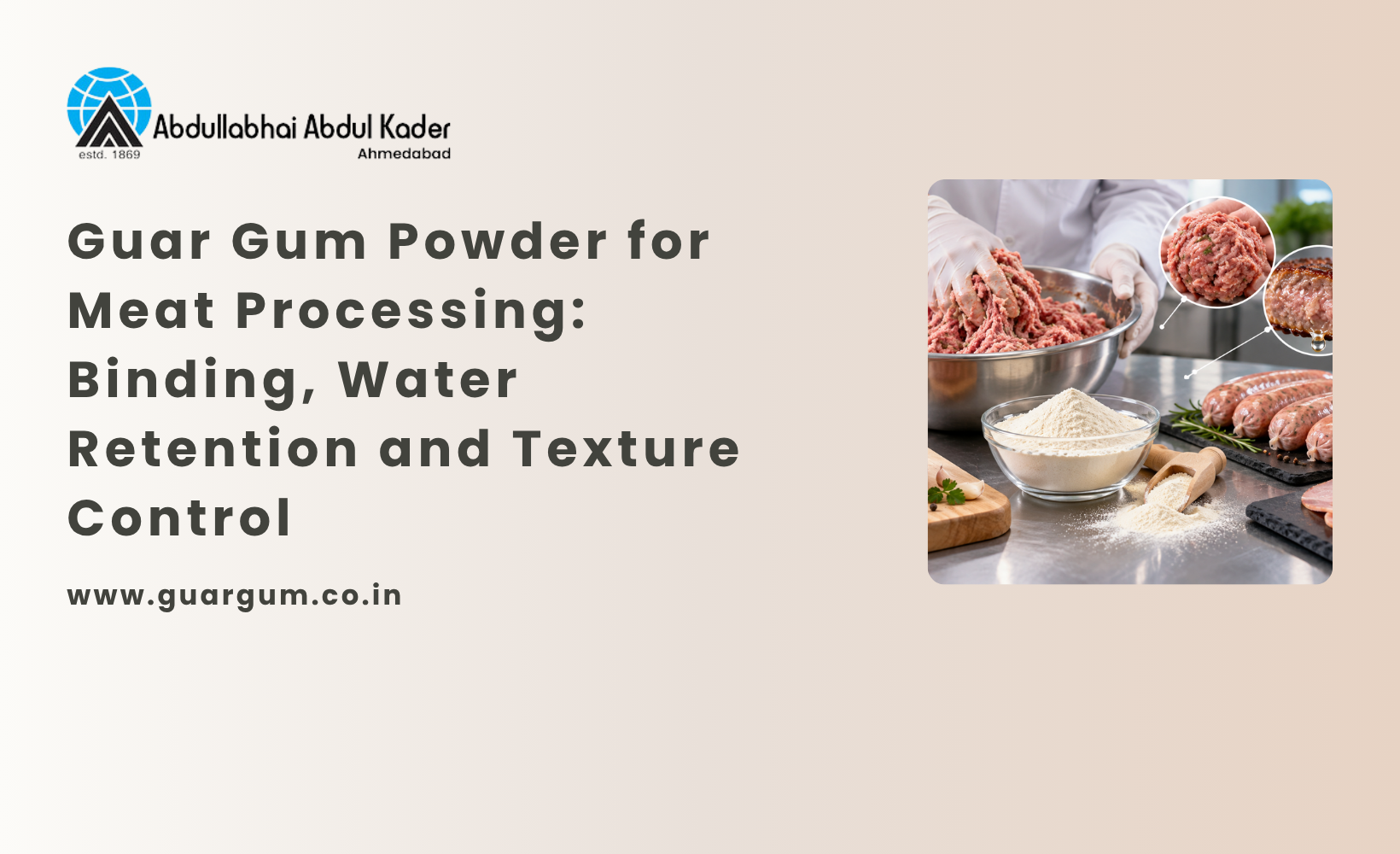
Objective:This article explains the potential functions of Guar Gum Powder in meat processing, including binding, water retention, texture control, formulation compatibility, processing considerations, product evaluation, and sourcing requirements.
Guar Gum Powder in Processed Meat Formulations
Guar gum powder is one of the ingredients processed meat manufacturers evaluate when a formulation needs more consistent binding, moisture management or texture. Sausages, patties, meatballs and restructured products depend on a mix that binds cleanly, holds added water, and delivers a matching texture. When any of these elements varies, processors see uneven slicing, soft or gummy bite, visible purge, or inconsistent cook yield.
Guar gum powder is a plant derived hydrocolloid that develops viscosity as it hydrates in water, and that single mechanism is the starting point for the distinct functions discussed later: binding support, water management, texture and viscosity control, and suspension or emulsion support. Which of these matters most depends on the meat type, water content, fat level, salt concentration, other proteins and binders already present, and the processing equipment used. A processor working with a guar gum powder supplier should be ready to describe the product category, the process and the specific problem addressed, since a general recommendation rarely fits every formulation.
Buyers evaluating a guar gum powder exporter usually ask how the material hydrates, its viscosity, particle size, purity, and whether microbiological data and batch consistency are documented. Guar gum powder applications span food, pharmaceutical and industrial sectors, so a grade suited to one use is not automatically right for a meat product. Defining the formulation objective, whether supporting cohesion in a restructured product or managing free water in a cooked sausage, should come before requesting samples or a quotation.
 Call Now !
Guar Gum Powder and Binding in Meat Products
Binding refers to how well a formulation's components hold together as a cohesive mass through mixing, filling, cooking and slicing. Guar gum powder may contribute to this cohesion by interacting with added water and other components, supporting ingredient distribution, matrix consistency, shape retention and slicing behaviour.
Binding in meat products is primarily driven by extracted myofibrillar proteins, salt, mechanical mixing energy, fat distribution, temperature, and where permitted, phosphates, starches and fibres. Guar gum powder does not replace the functional role these play, and any specific claim about improved binding strength or product integrity should be confirmed through the processor's own trials.
Guar Gum Powder for Water Retention and Moisture Management
Water binding describes how tightly water is held within the meat matrix, while water retention relates to how the added water is distributed through the formulation. In practice this is less about the mechanism and more about what a processor should measure during a trial: purge or free liquid in the pack, drip loss, cooking loss, finished yield, and appearance after chilled storage. These are the evaluation parameters that show whether a formulation manages moisture consistently, rather than an assumption about the ingredient's effect.
Results depend on water addition levels, meat protein condition, salt, fat level, mixing intensity, the heating and cooling profile applied, and any other water binding ingredients present. Guar gum powder should not be described as a guaranteed way to reduce purge, drip loss or cooking loss, and it does not function as a preservation or microbial control measure.
Guar Gum Powder for Texture and Viscosity Control
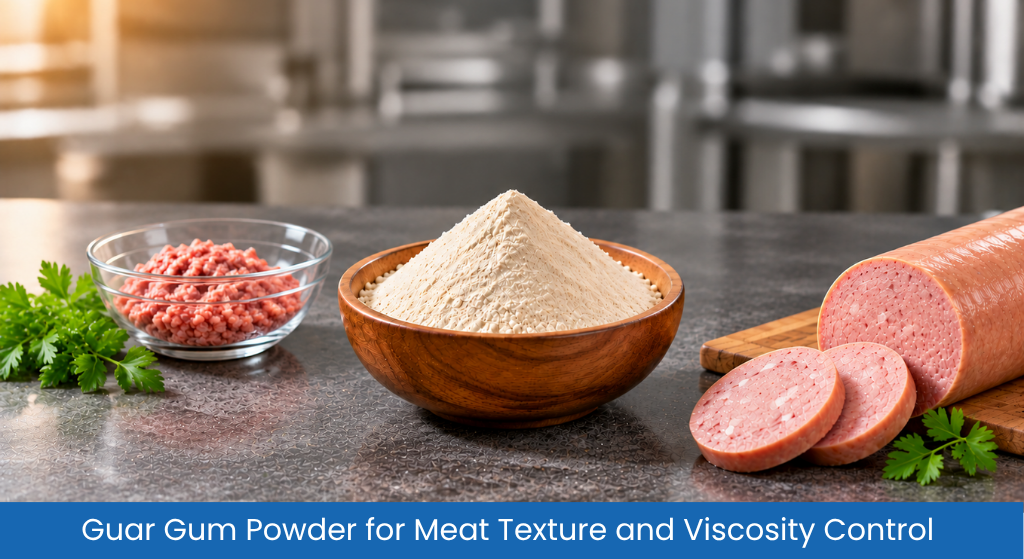
Texture outcomes in a meat formulation are best judged by what a processor and taster can actually assess: firmness, bite, cohesion, spreadability, slice structure, and whether the mixture fills into casings or moulds without difficulty. These effects vary by product category and by how the ingredient is incorporated during processing.
More is not automatically better. Excessive or poorly controlled addition can create an overly gummy texture, uneven hydration, difficulty during mixing or filling, and a product that misses the intended eating quality. Texture should be scored against a defined target for the product category using trial batches, since the same addition level can read as firm in one formulation and gummy in another.
Guar Gum Powder in Emulsion and Suspension Systems
An emulsion in a meat system typically involves fat dispersed within a protein and water matrix, while a suspension involves solid particles distributed through a liquid phase. In both cases, the practical concern is separation: whether fat or fine particles move and settle out before cooking or setting. Guar gum powder may help limit that movement, working alongside, not instead of, the functional proteins that primarily create and stabilise a meat emulsion.
Protein extraction, fat particle size, mixing energy, temperature, salt, water levels and other stabilisers all influence whether an emulsion holds through processing, and guar gum powder cannot guarantee prevention of fat separation or emulsion breakdown alone. These functions are commonly evaluated across sausages, emulsified meat products, patties, meatballs, restructured meat items, cooked meat preparations, processed poultry, and meat based ready meal components, and not every recipe within a category responds the same way.
Guar Gum Powder Compatibility with Other Meat Ingredients
Most processed meat formulations combine guar gum powder with meat proteins, added water, salt, fat, starches, fibres, and sometimes other hydrocolloids such as carrageenan, xanthan gum or cellulose based ingredients, along with seasonings, preservatives and phosphates where permitted. Combined with starches or fibres, the check should be on hydration speed and final viscosity, since water binding ingredients competing for the same water can behave differently together than either does alone. Combined with other hydrocolloids such as carrageenan or xanthan gum, the check should be on whether the blend gives the intended texture rather than assuming the effects simply add together. There is no universal compatibility guarantee, so a specific blend should be tested in the actual formulation before adoption.
Processing Variables That Affect Guar Gum Powder Performance
The same guar gum powder grade can perform differently across two trials that look similar on paper. The variables below explain why, rather than repeating how hydration works.
Preparation and Addition Method
Particle size, the method used to introduce the powder, mixing intensity and duration, and the order of ingredient addition all affect how completely the material disperses and how evenly it distributes through the mix. The company's product page references mesh size and granulation control, which is useful background when comparing addition methods, though a specific mesh choice should be confirmed against the intended application.
 Email Us Today!
Temperature Control
Temperature during chopping, mixing, filling, cooking and cooling affects protein behaviour, fat stability and final texture. Guar gum powder cannot compensate for poor temperature control elsewhere in the process.
Salt, pH and Water Chemistry
Salt, pH and dissolved minerals affect hydration speed, viscosity and ingredient interaction. Performance across a specific range should be verified for the exact formulation rather than assumed.
Quantity and Formulation Balance
Both insufficient and excessive addition create problems, from limited functional effect to excessive viscosity and gummy texture. A dosage range should come from the processor's own trials rather than a fixed figure.
Guar Gum Powder and Food Safety Boundaries
Guar gum powder's functional role has limits. It does not replace hygienic raw material handling, validated cooking and chilling, preservation systems, microbiological testing, allergen management, regulatory compliance or sanitation procedures. It should not be described as an antimicrobial, a preservative or a food safety treatment, and health related statements about it should be avoided unless separately verified.
Guar Gum Powder Trials for Meat Processing
Staged testing before routine production helps confirm whether a grade performs as expected. This includes product screening, formula review, hydration and viscosity evaluation, compatibility testing, small batch trials, mixing and filling assessment, cooking and cooling evaluation, texture and sensory assessment, and controlled production trials followed by finished product review.
Trials are most useful when they reflect actual production conditions: the specific meat type, fat level, added water, salt content, equipment, heating method, packaging and storage. Results from a different formulation should not be assumed to transfer directly.

Selecting a Guar Gum Powder Grade and Supplier
This stage answers a single question: is this grade, and this supplier, technically suitable for the formulation. Technical and quality teams typically review the intended product, required function, food grade suitability, viscosity behaviour, hydration characteristics, particle size, moisture, purity, colour, microbiological requirements, compatibility with other ingredients, and performance under the processor's own conditions. Batch to batch consistency and documentation, such as a Technical Data Sheet, Certificate of Analysis and Safety Data Sheet, are part of the same qualification. Selecting a product on viscosity or price alone can overlook requirements that matter for a meat application.
Bulk Procurement of Guar Gum Powder
Once a grade and supplier are technically qualified, bulk procurement addresses a different question: how to move from an approved trial to repeat commercial supply. This covers sample approval against the trial result, agreeing commercial order quantities, selecting an appropriate packaging format, protecting the material from moisture and contamination, tracking batch allocation, confirming storage conditions, agreeing lead times and shipment schedules, and for export orders, confirming export packaging and destination requirements. Reviewing documentation, planning inventory around repeat orders, and understanding claims and nonconformance procedures complete the picture. Minimum order quantities, pricing, delivery times, payment terms and shipping routes vary by order and should be confirmed directly.
About Abdullabhai Abdul Kader (Ahmedabad)
Abdullabhai Abdul Kader (Ahmedabad) manufactures guar gum powder, and the company's product page lists meat processing among the ingredient's food applications, alongside other food, pharmaceutical and industrial uses. The page presents the product as a thickening, stabilising, moisturising, curing and binding agent, with information on hydration, viscosity, granulation, mesh size, packaging and storage.
Abdullabhai Abdul Kader (Ahmedabad) lists multiple guar gum powder grades with general specifications, including moisture, ash content, gum content, viscosity range and microbiological parameters, with buyer-specific requirements available for direct discussion. Packaging is offered in twenty five kilogram HDPE paper-laminated bags with an inner liner, and the company notes a general shelf life of two years when stored in a dry place. Processors evaluating the company as a supplier or exporter can use this documentation as a starting point for further technical discussion specific to their formulation.
Conclusion
Selecting guar gum powder for a meat formulation should start with the target product and the specific function required, whether that is binding, moisture management, texture or emulsion support, since these are separate outcomes rather than one universal effect. From there, controlled trials against the processor's own conditions and verification of the supplier or exporter turn a general-purpose ingredient into a formulation-specific decision.
Meat processors, food formulators, distributors and procurement teams are welcome to share their product type, formulation objective, processing conditions, required quantity, packaging needs and documentation requirements with Abdullabhai Abdul Kader (Ahmedabad) to discuss whether a suitable grade is available for their application.