
Objective:This article explains the potential functions of Guar Gum Powder in mineral processing, including flocculation, ore beneficiation, slurry management, technical selection factors, process testing, and bulk sourcing considerations for mining companies and industrial buyers.
Guar Gum Powder in Mineral Processing Systems
Mineral processing depends on controlled interactions among ore particles, water, equipment and processing reagents. Fine-particle separation, uneven settling, inconsistent slurry flow, filtration resistance and selective mineral separation can influence plant performance. For this reason, guar gum for the mining industry must be evaluated against a clearly defined process objective. Guar gum is a water-interacting natural polymer that may support viscosity modification, particle interaction, suspension, binding or separation under suitable process conditions. These functions are different from one another, so the required role should be established before the material is introduced into a processing circuit.
Guar gum powder may be investigated for flocculation, ore beneficiation, slurry handling, filtration preparation and selected flotation systems. Its behaviour can be influenced by mineralogy, particle surfaces, water chemistry, pulp density, pH, mixing conditions, other reagents and the selected product grade. Buyers should therefore define the required function and evaluation conditions before comparing materials from different guar gum producers. A product intended to modify slurry viscosity, for example, should not automatically be expected to provide selective mineral depression or effective fine-particle aggregation.
When approaching guar gum manufacturers in India, mining companies should communicate the ore or slurry characteristics, process objective, water conditions, current reagent programme and expected functional response. This information gives the supplier a practical basis for discussing potentially suitable grades. A guar gum powder manufacturer should also provide clear product specifications, representative samples, batch information, packaging details and relevant technical documents. Initial discussions should not focus on viscosity or price alone because hydration behaviour, particle size, filtration characteristics, moisture, batch consistency and process compatibility may also affect product selection.
 Call Us Now!
Functional Roles of Guar Gum Powder
When dispersed correctly in water, guar gum powder hydrates and develops viscosity. This response may alter resistance to flow, the movement of suspended solids and the distribution of other reagents. Under suitable conditions, a polymer-based material may also interact with compatible particle surfaces and influence aggregation or surface behaviour. Binding may hold particles together, while suspension control may delay or modify settling. These effects must not be treated as identical merely because they originate from the same polymer.
The location and purpose of addition determine which characteristic matters. Thickening changes fluid consistency. Flocculation creates larger groups from fine particles. Suspension control affects how solids remain distributed within a liquid. Depression in flotation aims to reduce the tendency of selected particles to enter the floated product. A grade that produces high viscosity may still be unsuitable if it hydrates too slowly, filters poorly or creates a slurry that is difficult to pump.
Guar Gum in Flocculation and Solid Separation
Flocculation is the controlled aggregation of fine suspended particles into larger structures that may settle or filter more effectively. In polymer flocculation, interaction with compatible particle surfaces may create bridges between particles and encourage floc formation. In mineral processing, this principle may be evaluated for fine-particle aggregation, clarification, thickener-feed conditioning, filtration preparation and solid-liquid separation.
The potential response depends particularly on particle-surface behaviour and the way the reagent is prepared and introduced. Weak interaction may produce little aggregation, while excessive mixing after floc formation may damage fragile structures. Poor dispersion can also produce uneven hydration and inconsistent contact. These factors mean that performance cannot be assumed for a particular ore without relevant testing. Suitability should be determined by comparing settling, clarity, filtration and handling behaviour under controlled conditions that represent the intended circuit.
Flocculation Versus Coagulation
Coagulation and flocculation support particle separation through different mechanisms. Coagulation generally reduces the forces that keep fine particles dispersed, allowing destabilised particles to approach one another. Flocculation generally promotes the formation of larger particle groups through polymer interaction or bridging. The two processes may be used independently or in sequence, depending on the slurry and separation objective. Guar gum powder should not be described as a coagulant unless that function has been demonstrated in the system under discussion.
Guar Gum Powder in Ore Beneficiation
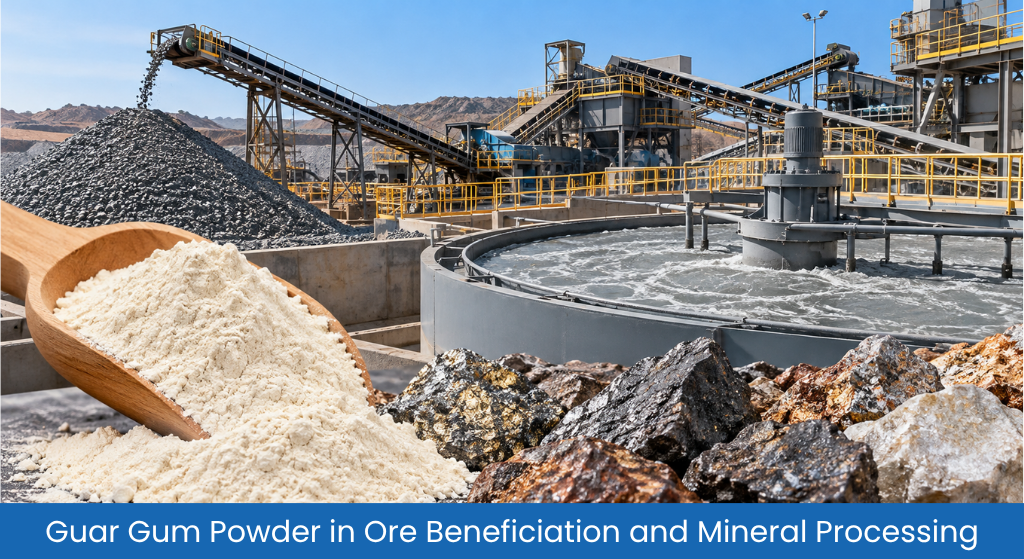
Ore beneficiation separates valuable mineral components from unwanted material. Within suitable circuits, guar gum powder may be investigated as a process aid for modifying fine-particle behaviour, limiting unwanted gangue interaction, adjusting slurry characteristics or supporting selective separation. Such use is application-specific. The product should not be described as improving recovery, gangue rejection or concentrate grade unless comparative results from the relevant ore and operating conditions support that conclusion.
Mineral associations and surface properties can vary between deposits and even between ore zones within one operation. Oxidation, contamination, degree of liberation and previous reagent exposure may change how particles respond. A result obtained with one sample therefore cannot be transferred automatically to another mineral system. Mineralogical understanding should guide the evaluation so that observed changes can be connected to the particles present rather than attributed broadly to guar gum.
Surface Modification in Flotation
In selected flotation investigations, guar gum powder may be assessed as a depressant or surface-modifying reagent. A depressant is intended to reduce the tendency of selected particles to report to the floated product. This differs from a collector, which promotes the flotation of targeted minerals, and a frother, which helps create and manage the froth phase. These roles should remain clearly separated when designing or reviewing a reagent programme.
Any assessment must consider how the material affects the selectivity already created by collectors, frothers and other modifiers. The sequence of addition and conditioning period may influence which surfaces encounter the polymer and how subsequent reagents behave. Flotation work should therefore compare the complete reagent scheme. Guar gum powder should not be assigned to a particular ore or presented as providing guaranteed depression without mineral-specific evidence.
Guar Gum Powder for Slurry Management
Hydration and viscosity development may influence slurry movement, mixing, fine-particle suspension, reagent distribution, pumping, settling and filtration. A controlled change in rheology may be relevant when a process needs better management of solids distribution or liquid consistency. However, the useful viscosity is determined by the process objective and equipment arrangement, not by the highest value shown on a specification sheet.
Excessive viscosity may restrict pumping, reduce mixing effectiveness, slow settling or increase filtration difficulty. Mechanical handling through pumps, recirculation loops and high-shear mixers may also influence hydrated polymer behaviour. Evaluation should therefore reflect the intended preparation, transfer and dosing arrangement. Measuring viscosity without considering the separation stage and handling equipment provides only partial information about application suitability.
Variables Affecting Mineral Processing Performance
Mineralogy determines which particle surfaces are available for interaction. Gangue composition, surface oxidation, contamination and earlier reagent exposure may influence adsorption or selectivity. Particle-size distribution changes the available surface area and probability of contact, while pulp density affects particle spacing, mixing and slurry viscosity. These variables help explain why the same material may behave differently across mineral processing operations.
Water chemistry is equally important. Dissolved salts, hardness, pH, recycled-water components and soluble minerals may influence hydration, viscosity and particle interaction. Plant water is therefore generally more representative than unrelated laboratory water. Preparation factors also include dispersion, water addition, mixing intensity, hydration time, solution concentration, order of addition, dosing location and contact time. Appropriate conditions must be established for the specific plant, equipment, water source and reagent system.
 Email!
Compatibility with Process-Water Additives and Reagents
Guar gum powder may encounter collectors, frothers, depressants, dispersants, coagulants, synthetic flocculants, pH modifiers, salts and other process-water additives. These materials can alter solution conditions, compete for particle surfaces or change how solids aggregate and separate. Compatibility assessment should examine the relevant combination and order of addition rather than assume that every reagent will behave independently.
This assessment helps identify whether an otherwise acceptable grade disrupts selectivity, creates unwanted viscosity or changes the function of another reagent. It may also show that the material requires a different preparation method or point of addition. Recording the complete reagent sequence and water conditions makes the results easier to interpret and reproduce.
Laboratory and Plant Evaluation
A staged evaluation programme provides the most reliable route from initial product review to potential plant use. Screening begins by defining the required function and comparing representative samples under relevant water and slurry conditions. Depending on the application, the programme may include hydration assessment, viscosity measurement, settling tests, clarity observations, filtration tests, flotation work and compatibility checks. Results should be compared with the plant’s existing operating baseline rather than an unsupported universal target.
Promising materials can progress to pilot work or a controlled plant-scale trial. Test records should identify the product batch, preparation method, solution condition, addition point, reagent sequence, water quality, slurry properties and observed process response. Keeping the complete evaluation process within this stage prevents individual application sections from repeating the same testing advice. It also provides technical and procurement teams with evidence for deciding whether the material is suitable and operationally manageable.
Selecting a Mining Application Grade
Grade selection should begin with the required function, followed by the product characteristics that may support it. Technical teams may need to review viscosity development, hydration, particle size, filtration behaviour, moisture, appearance, purity considerations and compatibility with the existing circuit. Procurement teams should confirm that the commercial specification reflects the approved sample and identifies the parameters relevant to the application.
A Technical Data Sheet, representative Certificate of Analysis and Safety Data Sheet where applicable help buyers understand the offered material and plan its handling. Sample approval should record the grade and batch identity so that the evaluation remains traceable. Choosing only by nominal viscosity may overlook slow hydration, unsuitable granulation or filtration behaviour. Choosing only by price can create a similar mismatch between the purchased material and its intended duty.
Evaluating Guar Gum Producers
Mining buyers should compare guar gum producers according to their understanding of the intended function and their ability to explain differences among available grades. Useful evaluation points include specification clarity, sample availability, batch-to-batch consistency, hydration and viscosity information, particle-size details, filtration information, traceability and communication when a quality concern arises. Equivalent product names do not necessarily indicate equivalent processing behaviour.
The supplier should be able to connect the evaluated sample, approved specification and subsequent commercial supply through clear batch identification. Buyers should also understand how deviations and nonconforming material will be addressed. This stage should focus on technical reliability, consistency and quality communication, leaving shipment and inventory requirements to the commercial procurement process.

Bulk Procurement and Documentation
Bulk purchasing should follow technical approval and specification alignment. Order planning needs to address quantity, packaging format, moisture protection, batch allocation, storage, lead time, shipment scheduling and repeat-order planning. Commercial details such as bag quantity, delivery period, price and dispatch arrangements must be confirmed for each order rather than inferred from a general product description.
The buyer should define which documents must accompany supply, including the applicable Certificate of Analysis, product identification and safety information. Receiving procedures should verify packaging condition, batch details and document agreement before the material enters inventory. A documented method for reporting claims or nonconformance helps protect the relationship between the approved sample and the product eventually introduced into the plant.
About Abdullabhai Abdul Kader (Ahmedabad)
Abdullabhai Abdul Kader (Ahmedabad) manufactures guar gum powder for industrial applications and identifies mining among the application areas listed on its product page. The company presents multiple general product grades and discusses viscosity, controlled hydration, granulation, filtration, packaging and dry storage. It also indicates that product characteristics can be discussed according to buyer requirements.
This information provides a basis for requesting product details and a representative sample. It does not establish that any listed grade is validated for flocculation, flotation, ore beneficiation or a particular mineral. Buyers should communicate the required function and complete an application-specific evaluation before approving commercial supply.
Conclusion: Selecting Guar Gum Powder for Mining Applications
Guar gum powder may be investigated for distinct functions in mineral processing, including flocculation, selective depression, viscosity modification and slurry management. These mechanisms should not be combined into one broad performance claim. Suitability depends on whether a particular grade produces the required response within the plant’s mineral, water, reagent and equipment conditions.
A sound decision connects a clearly defined application with appropriate grade characteristics, representative evaluation and an aligned commercial specification. Supplier assessment should focus on technical clarity, batch-to-batch consistency and traceability, while procurement should address packaging, documentation, shipment planning and repeat-order requirements.
Mining companies, mineral processors, formulators and distributors can share their application, ore or slurry conditions, required product function, quantity, packaging needs and documentation requirements with Abdullabhai Abdul Kader to begin a relevant product discussion.