
Objective:This article explains the food and industrial applications of Guar Gum Powder in the Netherlands, the factors affecting product selection and performance, and the practical considerations involved in sourcing bulk quantities from India.
Guar Gum Powder Demand Among Dutch Food and Industrial Buyers
For Dutch processors, importers, and formulators, guar gum powder is a functional raw material rather than only a traded ingredient. Its interaction with water can develop viscosity, bind moisture, stabilize dispersed components, suspend particles, and manage flow. These properties support suitable food processing, textile, paper, chemical, cosmetic, pharmaceutical, mining, and fluid handling uses. Guar is not commercially cultivated in the Netherlands, so Dutch users sourcing guar gum powder in bulk rely on international supply channels.
Food producers may consider food-grade guar gum powder for dairy products, ice cream, beverages, bakery goods, sauces, and processed meat. Industrial users may require different hydration, filtration, viscosity, or particle size characteristics. Companies evaluating guar gum powder export from India should define the application before comparing products and terms. A beverage grade may not provide the filtration required for textile printing.
Buyers planning a guar gum powder bulk order should set acceptance criteria for viscosity, hydration, particle size, purity, moisture, colour, filtration, microbiological expectations, packaging, and consistency. A qualified guar gum powder bulk supplier can use these details to identify a grade for evaluation. Dutch buyers contacting guar gum powder manufacturers in India should also communicate process conditions, quantity, documents, and schedule.
 Call Us Now!
What Drives Guar Gum Powder Import Demand in the Netherlands
The Netherlands has an established food processing base spanning dairy, bakery, beverages, confectionery, sauces, meat, and prepared foods. These sectors use hydrocolloids for texture, moisture, suspension, and flow control. Pharmaceutical, cosmetic, chemical, paper, textile, and other processors create further demand. Animal nutrition forms part of the wider ingredient economy, although feed suitability must be assessed separately.
Import demand arises because processors need guar-derived materials, while commercial guar cultivation occurs primarily outside the Netherlands. Dutch importers may supply domestic manufacturers, hold repeat stock, or distribute material across Europe. Port, warehousing, road, rail, and inland transport infrastructure makes onward distribution commercially relevant. Actual entry points and routes depend on cargo terms, warehouses, destinations, timing, and cost.
India has an established guar production and processing industry and is a major origin for guar entering Europe. For Dutch buyers, origin is only one consideration. An order also depends on functional suitability, specifications, packaging, documents, timing, and shipment coordination. Import demand is therefore linked to end use and supply capability, not an assumed growth rate.
Food Grade Guar Gum Powder Applications
Dairy Products and Ice Cream
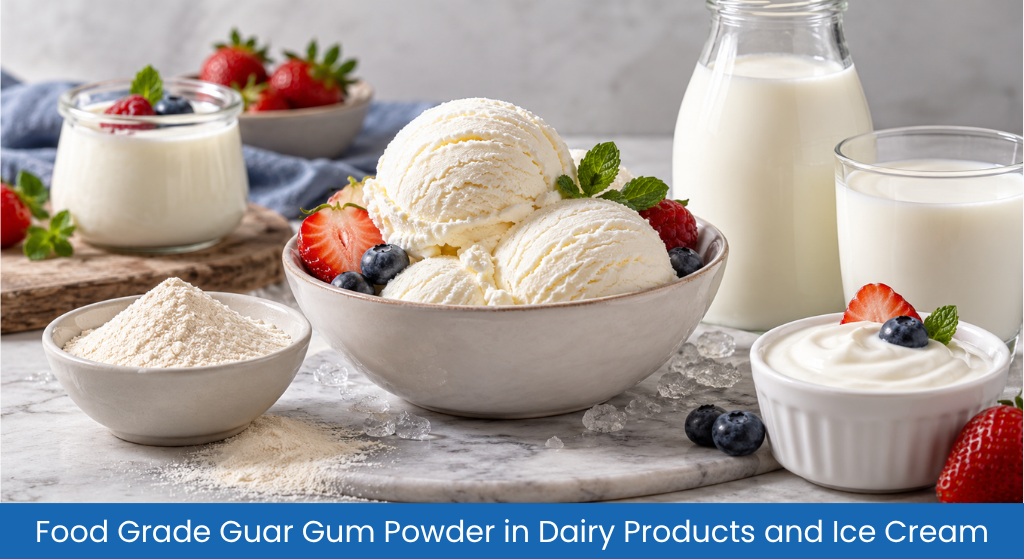
In dairy systems, guar gum can manage body, viscosity, moisture, and consistency. In ice cream, the product page identifies moisture and ice crystal control as relevant functions. Results vary with solids, fat, sugar, proteins, temperature, freezing, and other stabilizers. A frozen product therefore has different priorities from flavoured milk.
Sauces, Mayonnaise, Jam and Jelly
Sauces need predictable pour, spread, and cling, while mayonnaise must retain a dispersed structure. Jam and jelly combine water, sugar, fruit, and acidity. Guar gum may contribute viscosity, water management, and suspension. Salt, sugar, oil, pH, starch, and other gums affect behaviour. The objective is practical flow during mixing, filling, and use.
Bakery, Pasta and Confectionery Products
In bakery products, guar gum may contribute binding, moisture retention, consistency, softness, and structure. Pasta and confectionery processes may use its binding and texture functions. Flour, starch, protein, fat, sugar, mixing, resting, and heating affect performance. Buyers should define whether the priority is handling, moisture management, cohesion, or final structure.
Beverages and Flavoured Milk
Beverages and flavoured milk may contain cocoa or other material that settles. Guar gum can support suspension, viscosity, consistency, and mouthfeel. Lumping or excessive viscosity may interfere with pumping, homogenisation, filling, and acceptance. Developers must balance stabilization with the intended drinking character.
Processed Food and Meat Products
The product page includes sausages and ham among food applications. Guar gum may assist binding, moisture management, cohesion, and texture control. Salt, protein, fat, water, mixing, and heat influence results. These are processing functions, not nutritional or therapeutic benefits.
Industrial Guar Gum Powder Applications in the Netherlands
Paper and Textile Processing
Paper manufacturers may use guar gum for binding, fibre interaction, water retention, surface treatment, film formation, and strength. Textile printing pastes instead need controlled viscosity, flow, and filtration. Granulation and hydration affect both uses, but their criteria differ. Paper evaluation focuses on fibre and surface behaviour, while textile testing emphasizes paste preparation, filtration, print consistency, and chemical compatibility.
Paints, Ceramics, Mining and Adhesives
In paints, guar gum may support pigment suspension and flow. Ceramics can require binding and water control, mining formulations may need suspension, and adhesives may require cohesion and workable viscosity. Minerals, salts, pigments, resins, binders, and surfactants can alter behaviour, so each sector applies water interaction to a different purpose.
Oil Well Drilling and Fluid Systems
Application-appropriate grades may function as viscosifiers or gelling agents in water-based drilling and well-treatment fluids. Roles include viscosity, fluid-loss control, solids suspension, drilled material movement, and pumping performance. Salts, minerals, treatment chemicals, and demanding flow conditions require application-specific evaluation. Food-grade or general industrial material is not automatically suitable.
Pharmaceutical and Cosmetic Uses
Guar gum may provide binding or viscosity in tablet and suspension processes. In creams, lotions, gels, and personal care formulations, it may manage texture and consistency. Purity, microbiological expectations, compatibility, and process behaviour matter. Pharmaceutical suitability and regulatory status must be confirmed for the exact grade.
Technical Factors Affecting Guar Gum Powder Performance
Hydration and Viscosity Development
Hydration rate and viscosity can change with water quality, mixing, temperature, pH, salts, particle size, and addition order. Sugars, proteins, starches, hydrocolloids, surfactants, preservatives, minerals, pigments, and resins may create further interactions. Technical trials should reproduce the intended process.
Particle Size, Dispersion and Filtration
Particle size influences dispersion, hydration, lump formation, handling, filtration, and efficiency. The product page discusses control of granulation, hydration, viscosity, and filtration, but no mesh size is universally preferable. Equipment limitations, addition method, filtration needs, and hydration response should guide evaluation.
Storage and Batch Control
The product page advises dry storage and lists laminated bags with an inner liner for moisture protection. Packaging should remain closed, clean, and clearly identified by batch. The stated shelf life is two years from production, subject to applicable storage conditions. Batch control may examine viscosity, hydration, particle size, moisture, colour, purity, filtration, microbiological parameters, and records.
Buying Guar Gum Powder in Bulk for the Dutch Market
When planning a guar gum powder bulk order, buyers should begin with an application brief and agreed specification. Sample approval should precede commercial ordering. Quantity planning should consider consumption, warehouse capacity, safety stock, batch allocation, and European distribution. Packaging, moisture protection, lead time, scheduling, and cargo handling require agreement.
When purchasing guar gum powder in bulk, buyers should treat technical approval and logistics planning as parts of the same procurement process. Teams should confirm quantity, specification, packaging, batch identity, shipment documents, and claims procedure. Minimum quantity, price, payment, delivery, port, and route remain order-specific and require direct confirmation.
Bulk Sourcing and Supplier Evaluation
During guar gum powder export from India, the buyer should provide the intended application, process conditions, performance expectations, quantity, packaging, and required documents. The supplier can respond with a potentially suitable grade and representative information. Sample review and production trials should occur before the final commercial specification is accepted. Once approved, both parties can align batch allocation, production and dispatch timing, shipment documents, communication milestones, and repeat order planning.
A guar gum powder bulk supplier should be assessed on application understanding, specification clarity, sample support, technical communication, batch documentation, traceability, packaging, export coordination, and response to quality concerns. Price should be considered alongside fitness for use, consistency, moisture protection, and dependable communication.
 Email!
Guar Gum Powder Import Requirements in the Netherlands
Netherlands-based importers should determine product classification, intended end use, customs documents, labelling, food safety obligations, transport conditions, cargo insurance, and clearance responsibilities. Food ingredients placed on the European Union market are subject to applicable safety and traceability requirements, while pharmaceutical or industrial uses may involve different obligations. Importers should verify current requirements with qualified customs, regulatory, logistics, food safety, and trade professionals. A general product description or origin does not prove compliance.
The document set may include a commercial invoice, packing list, Certificate of Analysis, Technical Data Sheet, Safety Data Sheet where applicable, Certificate of Origin where required, transport document, batch details, product specification, packaging information, and application-related supporting material. Not every document applies to every shipment. Netherlands-based buyers should agree the set before dispatch and ensure that identity, batch numbers, quantities, labels, and records support traceability through receipt, storage, distribution, and manufacturing.
Rotterdam and other Dutch logistics facilities can support receipt, storage, and onward European distribution, but port selection should follow the actual commercial arrangement. Importers supplying several European customers may need coordinated inventory allocation, warehouse conditions, customs handling, and delivery schedules. Moisture protection is especially important during sea transport and storage because packaging damage can compromise powder condition. Supply planning should also allow time for document review, customs clearance, incoming inspection, and release of the batch before manufacturing or redistribution.
About Abdullabhai Abdul Kader (Ahmedabad)
Abdullabhai Abdul Kader (Ahmedabad) manufactures guar gum powder and presents several grades with general specifications on its product page. The company describes food, pharmaceutical, chemical, textile, cosmetic, paper, and oil well applications. It also discusses controlled granulation and hydration, along with viscosity and filtration options for particular requirements. Its listed packaging is 25 kg laminated bags with an inner liner, and the page advises dry storage. Buyers should confirm the appropriate grade, current specification, packaging, and available documentation for each application and order.
Conclusion
Guar gum powder is commercially relevant to Dutch food processors, industrial manufacturers, importers, and European distributors because it can support distinct viscosity, binding, suspension, moisture, texture, and flow requirements. Import demand reflects both the absence of commercial Dutch guar cultivation and the need for functional ingredients across established processing sectors. Reliable sourcing depends on matching grade performance with the intended process and connecting approval decisions with practical inventory and logistics planning.
Dutch buyers sourcing from India should align specifications, samples, production trials, packaging, documents, quantities, schedules, traceability, and import responsibilities before placing a commercial order. To begin a product discussion, buyers can share their application, required grade, expected performance, quantity, packaging needs, and documentation requirements with Abdullabhai Abdul Kader (Ahmedabad).