
Objective:This article explains the potential roles of Guar Gum Powder in paper manufacturing, including binding, retention, surface treatment, process compatibility, product selection, mill evaluation, and sourcing considerations.
Defining the Function Before Selecting a Paper Additive
Paper production depends on controlled interactions among fibres, fines, mineral fillers, water, and process chemicals. Fibre bonding contributes to sheet integrity, while fines and filler retention affect material distribution and whitewater solids. Drainage determines how readily water leaves the forming web, and formation describes how evenly fibres and particles are distributed. Surface properties and process consistency also influence whether the finished sheet meets its intended specification. For this reason, evaluating the role of guar gum in the paper industry begins with a clearly defined function rather than an assumption that one additive will improve every operating parameter.
Guar gum powder is a water-interacting polymer that develops viscosity as it hydrates. Depending on the product type and system, it may be evaluated for binding, suspension, flow control, or support for surface formulations. Internal addition introduces the material into the stock before sheet formation, whereas surface application places a formulation on an already formed sheet. These routes expose the polymer to different conditions. A proposed guar gum application must therefore identify where the material will be used and what measurable result is required. When assessing the role of a guar gum binder in the paper industry, mills should examine fibre type, refining, filler loading, moisture, pressing, drying, and the other additives already present.
Other guar gum powder applications may involve particle interaction, coating support, viscosity adjustment, water retention, and film formation, but these functions are not interchangeable.
 Call Us Now!
Functional Role of Guar Gum Powder in Paper Manufacturing
Guar gum powder hydrates in water and can modify aqueous flow. Its water-binding and hydrogen-bonding behaviour may be relevant to suspension, binding, film formation, and fibre-particle interaction. The required outcome determines the product type, preparation, addition location, dosage strategy, and evaluation method. Native guar gum powder is generally non-ionic, while modified guar can possess different charge or molecular characteristics that change adsorption, particle aggregation, compatibility, and shear response. Mills should confirm the offered product type and its intended use rather than treating the broad term “guar” as evidence that a grade can perform every paper-manufacturing function.
Guar Gum as a Binder in Paper Manufacturing
Binding means supporting cohesion among fibres, fines, fillers, or surface components. A suitable guar material may interact with cellulose-rich surfaces as water is removed. Internally, it may be evaluated for fibre contact, bond development, and sheet integrity; in a surface formulation, it may be assessed for surface cohesion, dust control, handling, or converting behaviour. Strength results cannot be attributed to the binder alone because fibre type and length, recycled content, refining, filler loading, sheet density, moisture, pressing, drying, and other additives influence paper properties. Mills should compare treated and untreated sheets under consistent conditions rather than assume improvements in tensile, burst, folding, or other strength measures.
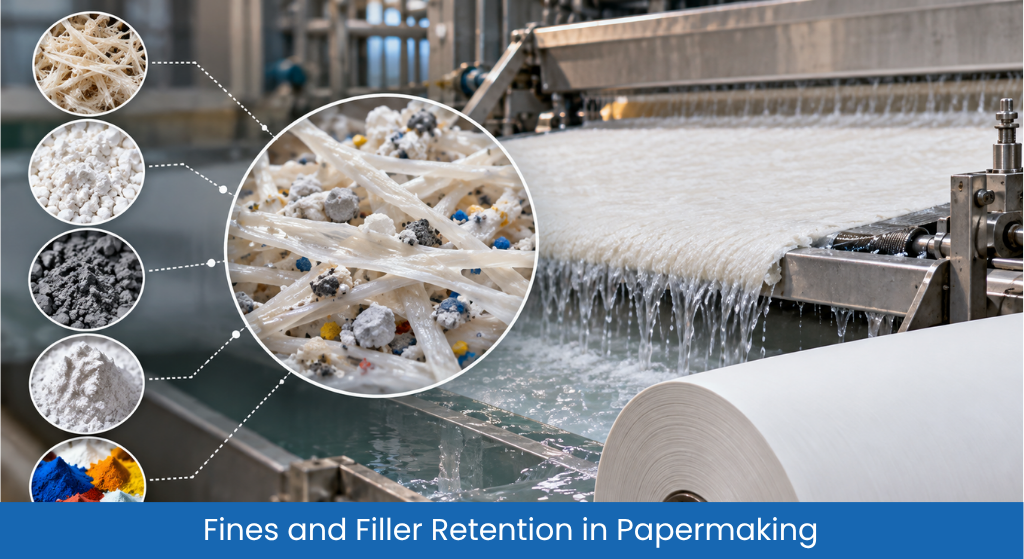
Fines and Filler Retention
Retention is the forming sheet's ability to capture fibres, fines, fillers, pigments, and other solids. Suitable guar-based materials may influence particle attachment, whitewater solids, formation, and process stability, but results depend on the electrical and physical conditions within the wet-end system. Native and modified guar may behave differently; specialised retention systems often rely on polymer charge, molecular architecture, and interaction with other programme components. A general native powder is not automatically a dedicated retention aid. Before making a retention claim, mills should confirm the exact product type and test it with the actual fillers, dissolved substances, conductivity, shear conditions, coagulants, and flocculants.
Retention and Drainage Are Not the Same
Retention concerns solids remaining in the sheet, while drainage concerns water leaving the furnish. Formation describes the distribution of fibres, fines, and fillers throughout the sheet. Greater viscosity or aggregation may assist one measurement while slowing another, and excessive flocculation may create localised fibre clusters, uneven filler distribution, visual variation, or inconsistent physical properties. Consequently, retention, drainage, formation, whitewater conditions, and machine operation must be evaluated together. Product quantity, dilution, mixing, and addition sequence require careful control so that a gain in one parameter does not create an unacceptable change elsewhere in the papermaking process.
Guar Gum in Surface Treatment Applications
In coating or sizing formulations, suitable guar gum powder may be evaluated for binder support, viscosity management, water retention, pigment suspension, film formation, surface cohesion, and application flow. Surface use differs from wet-end addition because it involves higher solids, defined binder and pigment components, specialised application equipment, and separate drying. Performance may vary with solids, pigment, binder system, viscosity, shear, application method, drying, and paper grade. Printability, smoothness, gloss, ink holdout, pick resistance, and coating strength must be tested on treated sheets, not presumed from solution viscosity.
Internal Addition Versus Surface Application
| Evaluation Area | Internal Addition | Surface Application |
|---|---|---|
| Point of Use | Added to the stock or furnish system | Applied after initial sheet formation |
| Main Purpose | Fibre interaction, binding, retention, or furnish control | Surface binding, viscosity control, film formation, or coating support |
| Key Variables | Furnish charge, shear, pH, water chemistry, and addition point | Solids, viscosity, binder compatibility, application method, and drying |
| Evaluation Method | Wet-end tests and controlled machine trials | Formulation tests, application trials, and finished-sheet testing |
The same grade should not be assumed suitable for both routes. Each use needs separate acceptance criteria.
Furnish Composition and Process Compatibility
Virgin and recycled fibres, hardwood and softwood pulps, and mechanical pulp differ in surface area, fines, contaminants, and bonding behaviour. Fillers and pigments add particle surfaces, while starch, sizing agents, strength additives, retention chemicals, dyes, and water constituents can alter the response to guar. Recycled water may also accumulate salts, suspended solids, and interfering substances, so changes in pH, hardness, or conductivity can affect polymer interaction even when dosage remains unchanged. Guar is therefore not universally compatible with every furnish or additive programme. Compatibility work should reproduce the actual fibre blend, filler system, process water, existing additives, and chemical-addition order as closely as practical.
Technical Variables That Affect Performance
Product Type, Hydration, and Preparation
Selection should consider native or modified form, charge, molecular characteristics, viscosity, solubility, particle size, hydration, and filtration. Preparation variables include water quality, temperature, mixing, powder-addition method, concentration, hydration time, holding time, and lump prevention. Poor dispersion may leave partially hydrated particles or create inconsistent viscosity and filtration problems. Establish the procedure from supplier guidance and confirm it with plant water and equipment.
pH, Water Chemistry, Shear, and Addition Point
pH, dissolved salts, hardness, conductivity, suspended solids, and reused process water may influence polymer behaviour, fibre adsorption, and filler interaction. Pumps, cleaners, screens, mixers, and approach-flow equipment then expose polymers and particle structures to shear. The selected addition point should provide enough mixing for uniform distribution without causing uncontrolled aggregation or excessive breakdown. Because machine configurations and chemical programmes differ, no universal addition location is suitable for every mill. Teams should assess the available mixing energy, residence time, downstream shear, dilution conditions, and proximity to other chemical additions before selecting and validating a point of use.
 Email!
Dosage and Process Balance
Too little product may have no useful effect; too much may raise viscosity, slow drainage, impair formation, promote deposits, or disturb a surface application. A controlled dose-response study should monitor stock flow, screening, drainage, whitewater solids, formation, press and drying behaviour, application consistency, and machine cleanliness. Operational measures such as production speed, web breaks, drying demand, energy use, and runnability should be recorded during trials, but they must remain testable outcomes rather than promised benefits. The appropriate quantity is the lowest validated level that meets the mill's defined performance criteria without creating unacceptable process or finished-sheet effects.
Laboratory Screening and Controlled Mill Trials
A staged evaluation reduces the risk of transferring laboratory assumptions directly to a paper machine. Initial work should document water and furnish, screen candidates, and examine product preparation. Compatibility tests should include existing additives and realistic addition sequences. Depending on the function, testing may cover drainage, retention, formation, relevant strength properties, surface behaviour, and finished-sheet characteristics. Where available, pilot testing offers an intermediate step. A machine trial should define the baseline, control planned changes, record conditions, and compare representative samples. Methods must reflect the paper grade, furnish, water, chemical programme, equipment, and final use. Acceptance limits should come from the mill's specification.
Selecting a Grade and Evaluating a Manufacturer
Teams should state the paper grade, function, point of use, furnish, filler system, and compatibility requirements. They should compare the relevant technical specification, packaging, storage, samples, and traceability. A Technical Data Sheet, batch-specific Certificate of Analysis, and Safety Data Sheet where applicable help connect an approved sample with commercial supply. Selection by viscosity or price alone may miss critical process requirements.
A manufacturer should identify whether a product is native or modified and provide trial-relevant specifications. Buyers should assess documentation, samples, batch identification, packaging, storage guidance, communication, repeat-order consistency, and procedures for deviations or nonconforming material.
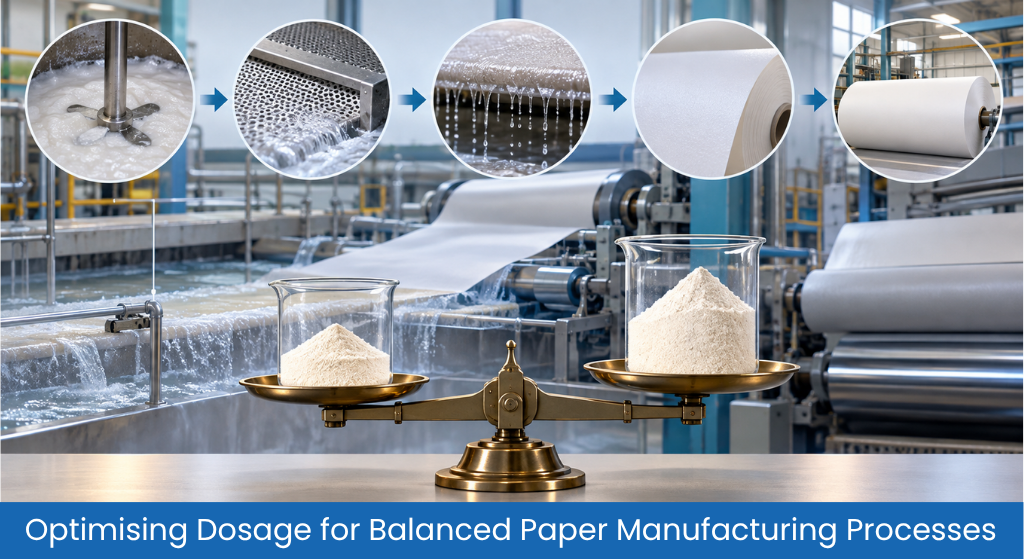
Bulk Procurement Considerations for Paper Mills
Commercial purchasing should follow technical approval. An inquiry should state the application, specification, order quantity, packaging, and documents. Trial and full orders may need different planning; moisture protection, batch allocation, storage, lead time, shipment scheduling, inventory, and repeat-order timing should align with production. Minimum quantity, price, packing configuration, delivery schedule, payment terms, and transport arrangements must be confirmed for each order. Procurement teams should also agree on receipt sampling, batch release, claims handling, and nonconformance procedures before routine supply.
About Abdullabhai Abdul Kader (Ahmedabad)
Abdullabhai Abdul Kader (Ahmedabad) manufactures guar gum powder and identifies paper among the industrial application areas listed on its product page, where binding is presented as a relevant property. The page lists several UNICOL grades with general specifications and discusses viscosity, hydration, granulation, filtration, packaging, and dry storage. It also states that granulation and hydration can be controlled for specific requirements and lists 25 kg HDPE paper-laminated bags with an inner liner. These details provide a basis for an inquiry, but suitability for a particular wet-end, retention, coating, or sizing use must still be confirmed through specification review and testing.
Conclusion: Selecting Guar Gum Powder for Paper Manufacturing
Guar gum powder may support binding, viscosity management, particle interaction, suspension, and surface-treatment formulations in selected paper-manufacturing processes. Its suitability depends on whether the mill requires wet-end addition, retention-system support, coating assistance, sizing support, or another clearly defined function. Native guar should not be treated as interchangeable with a specialised modified retention polymer.
Paper manufacturers should establish performance criteria and evaluate candidate grades through representative laboratory screening and controlled mill trials. Paper mills, chemical formulators, distributors, and procurement teams can contact Abdullabhai Abdul Kader (Ahmedabad) with their paper grade, furnish composition, intended point of addition, required function, quantity, packaging needs, and documentation requirements.