Objective:This article explains the potential applications of Black Seed Oil in cosmetic and nutraceutical manufacturing, including formulation uses, grade selection, quality considerations, stability, storage, supplier evaluation, and bulk sourcing.
Black Seed Oil as a Raw Material for Manufacturers
Black Seed Oil, pressed from the seeds of Nigella sativa and widely known as Kalonji Oil, is used by manufacturers as a botanical raw material rather than as a finished cosmetic or nutraceutical product. Its suitability for commercial production depends on factors such as botanical identity, processing method, consistency, applicable specifications, and performance within the intended formulation.
Black seed oil applications in cosmetics can include facial oils, body oils, creams, lotions, balms, serums, and hair or scalp preparations. Black seed oil in cosmetics is generally evaluated as an oil phase component or botanical ingredient, with its practical role determined by the formulation rather than by assuming a fixed cosmetic effect.
For manufacturers sourcing cosmetic grade black seed oil, the purchasing decision also involves the intended application, required documentation, sample evaluation, packaging format, and expected supply volume. Buyers purchasing black seed oil bulk may therefore evaluate a black seed oil manufacturer, black seed oil exporter, or black seed oil wholesale supplier according to defined technical and commercial requirements.
 Call Now !
Understanding Black Seed Oil as a Manufacturing Ingredient
From a manufacturing standpoint, Black Seed Oil is evaluated through its botanical identity, physical characteristics, processing history, and applicable quality specifications. Appearance, colour, and odour can form part of the raw material assessment where these characteristics are defined by the relevant specification or supplier documentation.
Formulators should distinguish between ingredient identity, functional formulation role, marketing claims, and verified specifications. Correct identification as Black Seed Oil does not by itself establish that a particular material will perform identically in every formulation or that a traditional use represents a confirmed cosmetic or nutraceutical benefit.
Depending on the application, Black Seed Oil may be incorporated into an oil phase, used as part of an anhydrous system, or blended with other oils and formulation ingredients. Its functional role is therefore determined by the product format, formulation design, processing conditions, and intended use.
Black Seed Oil Applications in Cosmetics
Black Seed Oil can be considered for a range of cosmetic formats, including skin care, hair care, cleansing oils, body oils, balms, and other personal care formulations. Its inclusion should be based on the requirements of the finished product rather than treating the oil as universally suitable for every cosmetic application.
For cosmetic development, formulators may assess:
- Compatibility with the other oils and ingredients
- Desired concentration in the finished formulation
- Sensory characteristics and final product feel
- Contribution to colour and odour
- Behaviour under expected storage conditions
- Compatibility with the formulation system
- Suitability of the selected packaging
The appropriate inclusion level is formulation dependent. It can vary according to the product format, sensory target, ingredient combination, processing method, and results from formulation trials.
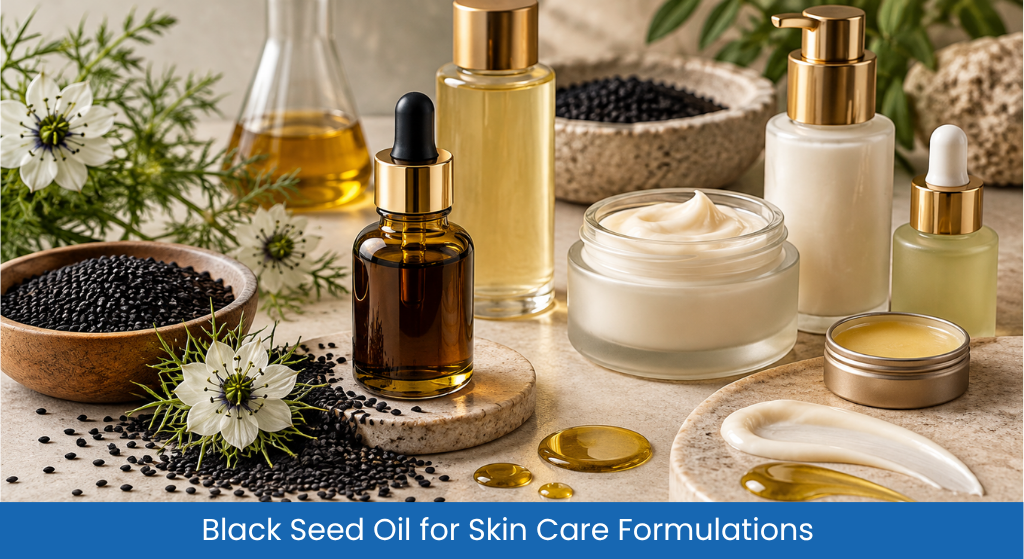
Black Seed Oil in Skin Care Formulations
Within skin care, the evaluation becomes more specific to the desired sensory and physical characteristics of the finished product. Formulators may consider spreadability, skin feel, oil phase compatibility, final texture, colour, and odour when determining whether a particular Black Seed Oil is appropriate.
Potential formats include facial oils, body oils, creams, lotions, balms, and serums. The suitability of the oil can differ between these formats because each may have different requirements for texture, appearance, processing, and stability.
Cosmetic communication should also distinguish formulation use from therapeutic claims. Statements that Black Seed Oil treats acne, eczema, psoriasis, inflammation, pigmentation, wounds, or infections should not be presented without appropriate supporting evidence. The same principle applies to claims involving guaranteed moisturising, anti ageing, antimicrobial, or healing effects.
Black Seed Oil for Hair Care and Scalp Care
Hair and scalp products may incorporate Black Seed Oil into formats such as hair oils, scalp oils, hair serums, conditioning products, and other botanical oil based formulations. The evaluation should focus on how the ingredient contributes to the intended product rather than assuming a particular benefit from traditional use.
Hair and scalp applications can require different sensory considerations from skin care. Formulators may assess whether the oil is suitable for a rinse off or leave on format, how it feels during application, how it distributes through the intended product, how its odour is perceived after application, and whether the selected dispensing system is appropriate.
Claims that Black Seed Oil prevents hair loss, promotes hair growth, treats dandruff, or resolves scalp conditions should not be made without suitable supporting evidence. Formulation trials and finished product evaluation provide a more appropriate basis for determining suitability.
Black Seed Oil in Nutraceutical Manufacturing
Nutraceutical manufacturing requires a separate assessment from cosmetic use. Buyers may need to consider the intended product format, raw material identity, applicable quality specifications, batch consistency, stability requirements, packaging, storage, documentation, and regulatory requirements for the destination market.
A cosmetic grade material should not automatically be considered suitable for nutraceutical manufacturing. Suppliers should provide appropriate documentation confirming the intended grade and use, while the buyer should establish whether the material meets the requirements of the finished nutraceutical product and applicable market regulations.
Oil based nutraceutical formats should therefore be evaluated independently from cosmetic formulations. The required specification, supporting documentation, compliance requirements, and product development process should be established according to the intended use.
Black Seed Oil Formulation and Processing Considerations
Formulation development should consider Black Seed Oil as part of the complete manufacturing system. Relevant factors can include oil phase selection, ingredient compatibility, mixing conditions, heat exposure, oxidation control, antioxidant compatibility, emulsification requirements, filling conditions, and the selected packaging system.
Processing conditions can influence characteristics such as colour, odour, and oxidative behaviour of the finished formulation. The appropriate process depends on the formulation and manufacturing setup, so laboratory and pilot trials can help establish suitable processing conditions before commercial production.
 Email Us Today!
Quality Parameters for Black Seed Oil
Technical evaluation of Black Seed Oil can be organised into several areas. Identity and physical quality may include botanical identity, appearance, colour, and odour. Chemical evaluation may include parameters such as acid value, peroxide value, or fatty acid profile where relevant to the specification. Safety and compliance requirements can include microbiological and contaminant considerations where applicable.
Batch consistency is another important consideration for manufacturers purchasing a raw material for repeat production. Results should be assessed against the applicable specification rather than against assumed industry values.
Not every parameter applies to every grade or application. Numerical limits, testing requirements, and acceptance criteria should therefore be confirmed through a current applicable standard, buyer specification, or official supplier documentation.
Cosmetic Grade Black Seed Oil Selection
Selecting cosmetic grade Black Seed Oil is primarily a matter of matching the material to the intended formulation. Buyers should first define the application, then evaluate whether the supplier's stated grade meets the technical requirements of that application.
The term cosmetic grade does not by itself provide a complete description of a material. Buyers should understand how the supplier defines the grade, review the available specifications and documentation, and request a representative sample where formulation evaluation is required.
Sample testing can help confirm whether the material's physical characteristics, sensory profile, compatibility, and processing behaviour are suitable for the intended product. Cosmetic suitability should also be assessed separately from nutraceutical suitability.
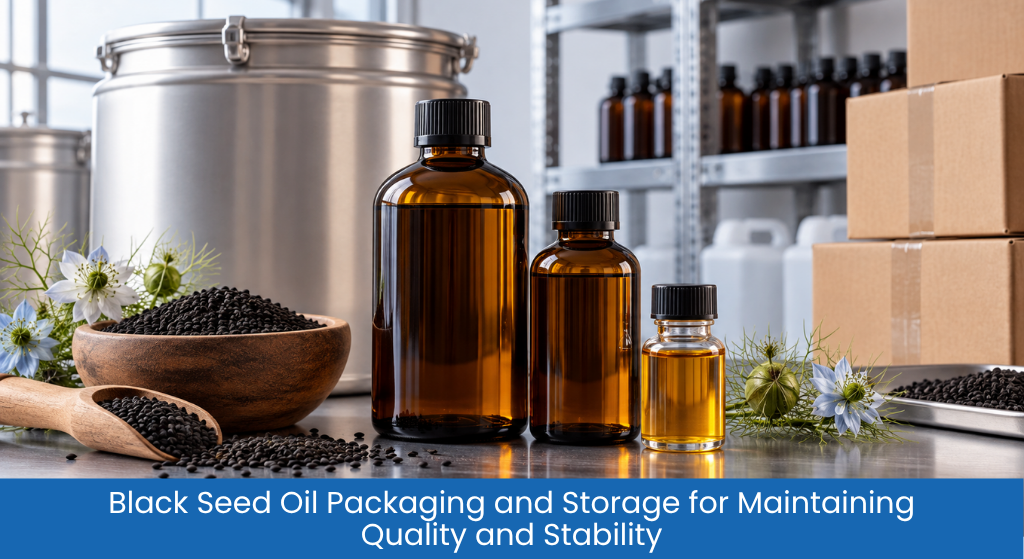
Black Seed Oil Stability, Packaging and Storage
After production, appropriate handling becomes important for maintaining the condition of Black Seed Oil during storage and transportation. Exposure to oxygen, light, heat, and moisture can be relevant considerations for botanical oils, while container compatibility, headspace, and repeated opening can also affect how the material is handled over its storage period.
Packaging should therefore be considered in relation to the expected transportation, storage environment, container opening frequency, and manufacturing schedule. The selected packaging system should be compatible with the raw material and the buyer's handling process.
Shelf life and recommended storage temperatures should not be assumed. Any specific storage condition or shelf life statement should be based on current official documentation applicable to the material being purchased.
Black Seed Oil Testing and Formulation Trials
Testing provides the link between raw material selection and commercial production. A practical development pathway can move from raw material approval to laboratory formulation trials, stability assessment, pilot production, packaging evaluation, and final commercial approval.
Each stage serves a different purpose. Laboratory testing can identify formulation compatibility issues, while stability studies help evaluate behaviour under defined conditions and pilot production helps determine whether the selected formulation and process remain suitable beyond laboratory scale.
A result obtained at one stage should not automatically be treated as proof of commercial performance. Formulation composition, processing conditions, concentration, packaging, storage, and manufacturing scale can all influence the final outcome.
Evaluating a Black Seed Oil Manufacturer
Qualifying a Black Seed Oil manufacturer should begin with technical information rather than general reputation. Buyers can review the product specification, confirm raw material identity, examine available manufacturing or processing information, and assess supporting documents such as a Certificate of Analysis and Safety Data Sheet where applicable.
Sample availability provides an opportunity to evaluate the material before commercial purchasing. Buyers can also assess how consistently the supplier provides documentation, communicates technical information, supports traceability, and manages batch related requirements.
A supplier evaluation should ultimately establish whether the manufacturer can provide material that meets the buyer's defined specification and can support the requirements of the intended production process.
Sourcing From a Black Seed Oil Exporter
International sourcing introduces additional considerations beyond technical material approval. Buyers working with a Black Seed Oil exporter should review export documentation, shipment packaging, protection during transit, destination storage requirements, and the documents required for receiving and customs procedures in the target market.
Sample approval before a larger shipment can help confirm that the material being considered is suitable for the buyer's application. Buyers should also establish destination market requirements before finalising an international purchase.
The country of origin or export location alone should not be treated as evidence of quality, suitability, or commercial advantage. Those factors should be assessed through the material specification, supplier documentation, sample evaluation, and agreed commercial terms.
Black Seed Oil Bulk and Wholesale Procurement
Once the material and supplier have passed the required technical evaluation, bulk procurement shifts toward commercial planning. Buyers should determine expected consumption, order quantities, container requirements, delivery frequency, and storage capacity before confirming a purchasing arrangement.
For repeat manufacturing, procurement teams may benefit from establishing an ordering schedule based on actual consumption and production planning. Packaging and container sizes should also be selected according to the buyer's handling and storage capabilities.
Pricing, minimum order quantities, delivery schedules, payment conditions, and other commercial terms should be confirmed directly with the supplier for each purchasing arrangement.
About Abdullabhai Abdul Kader
Abdullabhai Abdul Kader is presented as a supplier of Kalonji, including Nigella sativa seed and oil, for buyers seeking natural raw materials for manufacturing applications. Black Seed Oil is supplied as a botanical raw material, while suitability for a particular cosmetic or nutraceutical application depends on the grade, specification, documentation, and intended use.
Manufacturers and procurement teams considering Black Seed Oil can request current product information, applicable specifications, grade details, and relevant documentation before proceeding with commercial purchasing. Application requirements, quantity, packaging, storage, and documentation needs can then be evaluated according to the buyer's specific sourcing requirements.
Conclusion
Selecting Black Seed Oil for manufacturing is ultimately a matter of matching the raw material to the intended application and verifying its suitability through defined technical and formulation requirements. Product identity, applicable quality parameters, formulation behaviour, stability considerations, and supplier documentation all contribute to that decision.
Cosmetic and nutraceutical applications should be evaluated separately because the requirements for each use can differ. A material considered suitable for a cosmetic formulation should not automatically be treated as appropriate for an oral nutraceutical product without separate confirmation of its grade, specification, documentation, and applicable requirements.
For manufacturers, personal care brands, nutraceutical companies, distributors, and procurement teams, a structured sourcing process can reduce uncertainty before larger commercial purchases. Abdullabhai Abdul Kader (Ahmedabad) can be contacted to discuss the intended application, required grade, quantity, packaging requirements, documentation needs, and sourcing requirements for Black Seed Oil.