
Objective: This article explains the industrial applications of Guar Gum Powder in Norway, the technical factors that influence product performance, and the practical considerations involved in sourcing suitable grades from India.
Industrial Guar Gum Powder for Norwegian Buyers
Industrial guar gum powder is a functional material used to develop viscosity, bind water, stabilize mixtures, suspend particles, improve texture and manage flow in suitable manufacturing processes. For Norwegian buyers, its relevance depends on the required function within a specific food or industrial formulation. Oil-well fluids, food products, paper processing, textile production, chemical mixtures, cosmetics and pharmaceutical formulations may require different product characteristics. Buyers must therefore begin with a clear understanding of the intended application rather than treating every available grade as interchangeable.
The required performance should be established before samples or quotations are requested from guar gum powder manufacturers in India. For companies considering guar gum powder export from India, a clear technical specification allows a supplier to recommend a potentially suitable grade and helps the buyer compare products according to performance rather than price alone. Important purchasing considerations can include viscosity behaviour, hydration response, particle size, filtration needs, moisture, appearance, purity, packaging and batch consistency. A capable guar gum powder manufacturer should be given enough application information to understand what the buyer expects from the material.
Guar gum powder can perform several functions because of its ability to hydrate in water and develop viscosity. The approved product information identifies its use as a thickener, stabilizer, binder, moisture-retention agent, gelling aid and material for controlling the settling of solid particles. However, its actual behaviour may be affected by product grade, temperature, pH, salt content, water conditions and the other ingredients present in a formulation. Product selection should consequently be connected to measurable process requirements and an appropriate evaluation procedure.
 Call Us Now!
Industrial Applications of Guar Gum Powder in Norway
Oil-Well Drilling and Fluid Systems
Suitable guar gum powder grades may be used in water-based drilling and oil-well treatment systems where controlled viscosity, gelling, fluid movement and suspension are required. The product information also discusses fluid and water loss control, lubrication, flowability, pumpability and the movement of materials within oil-well applications. These functions can help technical teams consider how a particular grade may behave within a defined fluid system.
Drilling fluid buyers should concentrate on the behaviour of the material in the expected water and chemical environment. Dissolved salts, minerals, fluid composition, pumping conditions and filtration requirements may influence the required grade. Products intended for food or general industrial processing should not automatically be considered suitable for drilling fluids. The supplier should understand the intended fluid system and the performance parameters used by the buyer to assess it.
Food Processing Applications
In food manufacturing, guar gum powder can support texture, viscosity, stabilization, binding, moisture retention and the distribution of dispersed ingredients. The company product page identifies uses in ice cream, dairy products, drinks, flavoured milk, pudding, jam, jelly, bread, biscuits, bakery products, sausages, ham, mayonnaise, pasta and confectionery products.
The required function varies considerably among these applications. In ice cream, the material may contribute to texture and help control moisture and crystal development. In bread, cakes, pastries and biscuits, its binding and moisture-retention properties may support softness and consistency. In beverages and flavoured milk, the priority may be the stable distribution of ingredients and controlled flow. Sauces, mayonnaise, jam, jelly and pudding may require a particular balance between viscosity, texture and processability.
Food buyers should define the required purity, appearance, microbiological parameters, hydration behaviour and interaction with other ingredients. Proteins, starches, sugars, salts and other formulation materials may change the way a selected grade behaves. Documentation and product specifications must relate to the exact grade being considered for the intended food process. No general industrial grade should be assumed to satisfy food manufacturing requirements without appropriate verification.
Paper Manufacturing Applications
The binding and water-retention properties of guar gum powder may support selected paper manufacturing processes. According to the approved product information, the material can interact with paper fibres and contribute to binding and tensile strength. Depending on the process, buyers may also examine its role in surface treatment, film formation, water management and mixture consistency.
Paper manufacturers should focus on solution uniformity, fibre interaction, viscosity and the behaviour of the material within their processing equipment. The selected product must be suitable for the required preparation method and should not create avoidable handling or filtration difficulties. The intended paper grade, fibre system, process water, additives and equipment conditions should guide the performance specification.
Textile Printing and Processing
Textile applications have different requirements from paper production. Guar gum powder may be used to control paste viscosity, support printing consistency, bind formulation components and manage water within suitable textile processes. The company product page refers to controlled product characteristics and alkaline soluble gums intended for textile use.
For textile processors, granulation, hydration, filtration and compatibility with dyes or process chemicals can be important. An unevenly prepared paste may affect handling and application consistency. Buyers should therefore explain the type of textile process, preparation method, filtration arrangement and expected paste behaviour when discussing grade selection with a supplier. These details provide a clearer basis for identifying a suitable product than a general request for textile grade material.
Chemical and Mineral Formulations
Chemical and mineral-based formulations may use guar gum powder for suspension, binding, thickening, water management or flow control. The importance of each function depends on the material being processed. Pigmented products may require stable distribution of solids and suitable application flow, while ceramic mixtures may depend more on water retention and mineral suspension. Adhesive systems may place greater importance on binding, workable viscosity and uniform application.
Minerals, pigments, salts, resins, binders and other chemicals can influence product behaviour. A specification developed for one formulation should therefore not be transferred automatically to another. Buyers should identify the principal manufacturing challenge, such as settling, inconsistent flow, insufficient binding or poor water management, and communicate that requirement when discussing a potentially suitable grade.
Pharmaceutical and Cosmetic Uses
Guar gum powder may provide viscosity, binding, suspension and texture control in selected pharmaceutical and cosmetic formulations. Potential applications identified by the company include tablet processing, creams, lotions, gels and other personal care or pharmaceutical preparations. The function required in a tablet process will differ from the role expected in a cream, lotion or suspension.
These applications require careful consideration of the exact grade, purity, microbiological characteristics, appearance and batch information. The presence of preservatives, surfactants, active ingredients and other formulation materials may also affect product selection. General industry use does not confirm that a particular grade is suitable or compliant for a regulated application. Buyers must verify suitability and applicable requirements for the exact product and intended use.
Technical Performance Factors for Guar Gum Powder
Hydration and Viscosity Development
The company product information explains that guar gum powder can hydrate in cold water and develop substantial viscosity at relatively low concentrations. It also states that viscosity is influenced by temperature, pH and salt content. These variables should be considered when buyers define test conditions and compare candidate grades.
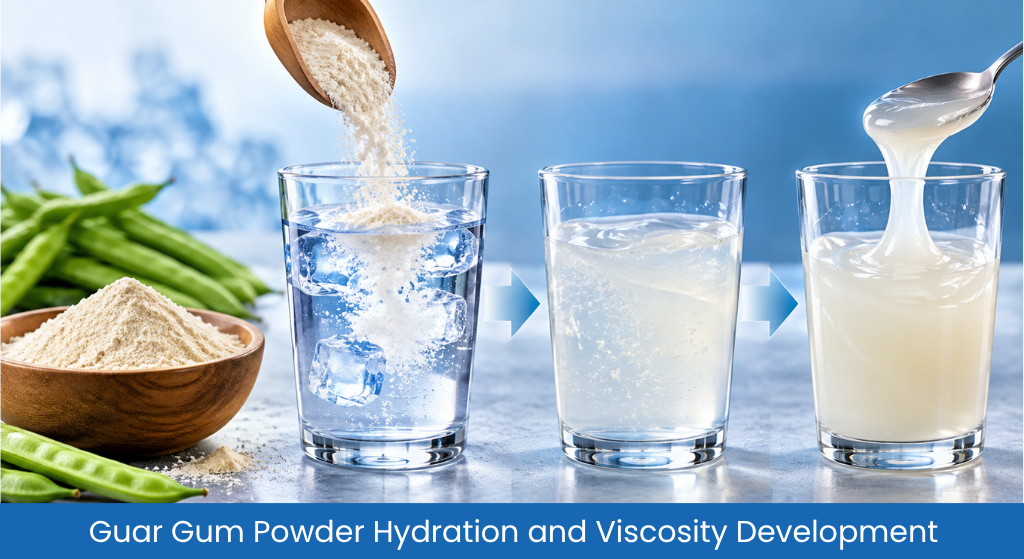
Mixing conditions, hydration time, particle size, water quality and the formulation environment may also need to be incorporated into the buyer’s assessment. Results obtained under one set of conditions may not represent performance in another process. Technical teams should consequently use a consistent evaluation method that reflects the intended production environment. Exact dosage, temperature, mixing time and viscosity targets should be determined for the particular formulation rather than assumed from general product information.
Particle Size and Filtration
Particle size can affect how the powder is handled, dispersed, hydrated and processed. It may also influence filtration and the uniformity of the prepared mixture. The company product page discusses controlling granulation and hydration to meet specific product requirements and refers to viscosity and filtration as characteristics that can be adjusted for particular uses.
Norwegian buyers should describe any filters, pumps, spray equipment, narrow passages or other processing components that may influence product selection. They should not request a particular mesh size without connecting it to an actual manufacturing requirement. Particle size must be evaluated together with hydration behaviour, material handling and the intended equipment arrangement.
Compatibility with Other Ingredients
The product information states that guar gum powder is compatible with various organic and inorganic substances, certain dyes and numerous food constituents. Even so, a buyer must assess how a selected grade behaves within the complete intended formulation.
Salts, proteins, starches, minerals, pigments, surfactants, preservatives, resins and other hydrocolloids may influence viscosity or mixture consistency. The purpose of compatibility assessment is to determine whether the material delivers the required function alongside these components. It should focus on observable processing and product performance without assuming that general compatibility guarantees suitability in every formulation.
Storage and Batch Control
The approved product page recommends storing guar gum powder in a dry place. It also specifies packaging in laminated bags with an inner liner. Moisture protection and clean handling remain important during transportation, warehousing, opening and internal movement of the material. Buyers should maintain clear batch identification and avoid storage conditions that may expose the powder to moisture or contamination.
Batch review may include viscosity behaviour, hydration response, particle size, moisture, colour, appearance, purity, filtration performance and microbiological parameters where applicable. The selected checks should reflect the intended use and the agreed commercial specification. Consistent testing methods make comparisons between approved and delivered batches more meaningful.
Selecting the Appropriate Industrial Guar Gum Powder Grade
Product selection should be based on a written performance specification. This specification can identify the intended function, expected viscosity behaviour, hydration characteristics, particle size, filtration needs, moisture considerations, appearance, purity and microbiological expectations where relevant. It should also describe the representative water, ingredients and process conditions used during evaluation.
After identifying a potentially suitable grade, the buyer should assess a representative sample through laboratory testing. If the initial results are acceptable, a production trial can confirm how the product behaves with the buyer’s equipment, batch size, ingredient sequence and operating method. Commercial approval should be connected to the tested grade and agreed specification. This structured process reduces the risk of selecting a product only because it has a familiar description or a lower quoted price.
Sourcing Guar Gum Powder from India
Effective sourcing begins with a complete technical and commercial enquiry. The buyer should state the intended application, required performance, expected quantity, packaging needs and any application-related quality requirements. This information gives the manufacturer a practical basis for discussing available grades and arranging an appropriate sample.
Following technical approval, both parties should confirm the commercial specification, packaging format, order quantity, production planning, batch allocation, dispatch timing and communication process for repeat purchases. Prices, minimum order quantities, production periods, payment arrangements, delivery schedules and transport plans should be confirmed for each transaction. They should not be assumed from previous orders or general market practices.
Guar Gum Powder Procurement and Norway-Specific Import Requirements
Procurement discussions should focus on commercial quantity, packaging, moisture protection, shipment scheduling, cargo handling and required transaction documents. Depending on the product and shipment, buyers may need to review a commercial invoice, packing list, Certificate of Analysis, Technical Data Sheet, Safety Data Sheet where applicable, transport documents, Certificate of Origin where required, product specification, packaging information and batch details.
The exact document set depends on the intended use, buyer requirements, product classification and shipment arrangement. Norwegian importers should confirm customs documentation, labelling, transport conditions, cargo insurance, customs clearance and any food, pharmaceutical, cosmetic or industrial obligations with qualified customs, regulatory, logistics and trade professionals. Product approvals, duties, tax rates, classifications and regulatory permissions should never be assumed without current verification.
How to Evaluate a Guar Gum Powder Manufacturer
Manufacturer evaluation should examine technical understanding, clarity of specifications, ability to discuss suitable grades, batch consistency, traceability and responsiveness. The supplier should be able to understand the buyer’s application and communicate clearly about the offered product without making unsupported suitability claims.
Buyers should also consider how the manufacturer manages sample identification, commercial batch information, packaging requirements, export coordination and quality concerns. Communication after delivery is as important as communication before the order. A structured process for reporting, investigating and resolving differences can support more consistent repeat purchasing.
 Email!
About Abdullabhai Abdul Kader (Ahmedabad) as a Guar Gum Powder Manufacturer
Abdullabhai Abdul Kader (Ahmedabad) manufactures guar gum powder for thickening, stabilization, binding, gelling, moisture management and other suitable functions. Its product page identifies uses across food, pharmaceutical, chemical, textile, cosmetic, paper and oil-well applications.
The company presents several product grades with general specifications and discusses the control of granulation, hydration, viscosity and filtration for specific requirements. It also provides packaging and dry storage information.
Selecting Guar Gum Powder for Norwegian Industrial Use
Industrial guar gum powder can support viscosity control, stabilization, binding, suspension, texture and water management in suitable Norwegian manufacturing processes. The required product characteristics depend on the intended application, formulation, operating environment and equipment.
A reliable purchasing process connects a clear performance specification with sample testing and production approval. Commercial terms, packaging, shipment documentation, batch traceability and Norway-specific import responsibilities should then be confirmed before the order is finalized.
Norwegian industrial buyers can contact Abdullabhai Abdul Kader (Ahmedabad) with their application details, expected product performance, required quantity, packaging preferences and documentation needs to discuss a potentially suitable guar gum powder grade.