


Guar Gum Powder in Fermented Foods: Role in Yogurt, Kefir and Probiotic Drinks
The global fermented food and drink market is experiencing a sustained growth cycle driven by consumer interest in gut health, the science of probiotics, and the broader trend toward functional foods. Yogurt, kefir, kombucha, probiotic drinks, and plant-based fermented alternatives are moving from health food stores into mainstream grocery retail, and the manufacturers supplying this demand face a consistent technical challenge: how to maintain the right texture and stability in a product that is biologically active and continues to change during its shelf life.
Guar gum powder in fermented foods addresses this challenge directly. It provides texture, stability, and viscosity control in formulations where live cultures are present, without interfering with fermentation activity or compromising the clean-label profile that buyers in this category demand. This article covers the science, the applications, and what food manufacturers need to know when sourcing guar gum powder for fermented product production.
Guar Gum Powder in Fermented Foods: Understanding the Technical Challenge
Fermented food and drink formulations present a different set of challenges from conventional food products. The presence of live bacterial cultures means the product continues to evolve after manufacture. pH drops as fermentation progresses. Syneresis, the separation of liquid whey from the gel structure in yogurt or the separation of liquid from the curd in kefir, is a persistent quality issue that consumers notice and reject. Texture can become thinner or more stringy over shelf life as the protein matrix breaks down.
Hydrocolloids like guar gum powder are used to address these challenges. Their water-binding capacity and gel-forming properties stabilise the protein network in fermented products and maintain acceptable texture across the intended shelf life. The key requirement is that the hydrocolloid chosen must be compatible with the fermentation environment and must not inhibit the activity of the probiotic cultures that give the product its functional value.
 Call Us Now!
 Guar Gum Powder Compatibility with Live Bacterial Cultures
Guar gum powder is a non-ionic polysaccharide. This means it does not carry an electrical charge that would interact with the proteins or the charged surfaces of bacterial cells in the fermentation medium. This is an important property because some hydrocolloids can interfere with culture activity or destabilise the protein network in ways that affect fermentation outcome.
Research and commercial production experience have confirmed that guar gum powder at typical usage levels in yogurt and kefir formulations does not inhibit Lactobacillus or Bifidobacterium strains. Compatibility extends to the yeast and lactic acid bacteria combinations used in kefir production. The galactomannan structure of guar gum is not fermented by standard yogurt or kefir cultures, meaning it remains structurally intact throughout the fermentation and storage period.
Read Our Article
How to Use Guar Gum Powder in Food Processing?Guar Gum Powder in Yogurt: Texture, Syneresis Control and Stability
Yogurt is the largest volume application for guar gum powder in the fermented food category. Whether the product is set yogurt, stirred yogurt, drinking yogurt, or a plant-based yogurt alternative, guar gum powder contributes in measurable ways to product quality.
Syneresis Control in Yogurt with Guar Gum Powder
Syneresis in yogurt is the appearance of liquid whey on the surface or at the base of the product. It is one of the most common consumer complaints about yogurt quality and one of the most commercially significant quality failures for manufacturers. Guar gum powder reduces syneresis by:
- Binding free water within the gel matrix, reducing the amount of mobile moisture available to separate from the protein network
- Reinforcing the casein gel structure that forms during fermentation, making it more resistant to physical stress during transport and handling
- Reducing the rate of post-fermentation syneresis during cold storage, extending the period during which the product presents acceptable visual quality
Texture Improvement in Stirred and Set Yogurt
Guar gum powder improves the mouthfeel and perceived richness of yogurt formulations. Even at low usage levels of 0.1 to 0.3 percent:
- Body and thickness are improved, making the yogurt feel more substantial and satisfying to eat
- Smoothness of texture is enhanced, particularly important in stirred yogurts where the gel is broken before packaging
- Post-opening texture is maintained for longer, meaning the product continues to look and feel acceptable over the consumption period
Guar Gum Powder in Plant-Based Yogurt Alternatives
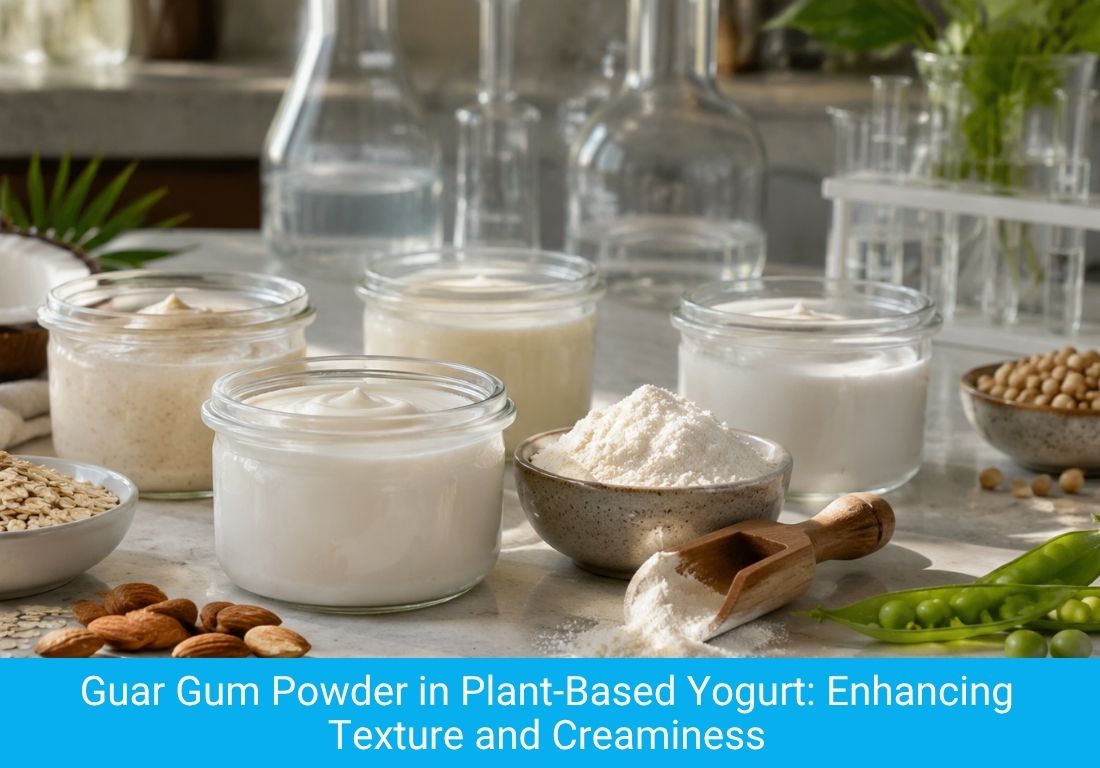
Plant-based yogurt made from oat, almond, coconut, soy, or pea protein bases presents more significant texture challenges than dairy yogurt. The protein networks in plant-based formulations are less robust than casein networks, and the risk of syneresis and texture collapse is higher. Guar gum powder is widely used in plant-based yogurt formulations at usage levels of 0.2 to 0.5 percent to:
- Compensate for the weaker gel-forming capacity of plant proteins
- Provide the body and creaminess that consumers expect but that plant proteins alone cannot deliver
- Maintain stability during the fermentation process, which behaves differently in plant-based substrates
- Prevent syneresis during cold storage, which is particularly pronounced in plant-based formulations
Guar Gum Powder in Kefir: Managing Viscosity in a Complex Fermented System
Kefir is a more complex fermented dairy product than yogurt. It is produced using a combination of lactic acid bacteria and yeasts, resulting in a product with a characteristic slightly effervescent, tangy character and a thinner, more drinkable texture than yogurt. Managing viscosity and stability in kefir while preserving the activity of this more diverse culture system requires careful ingredient selection.
Guar Gum Powder Functionality in Kefir Formulation
In kefir production, guar gum powder is used at low levels, typically 0.05 to 0.15 percent, to:
- Provide a degree of body to the finished product without making it unacceptably thick or reducing its drinkability
- Reduce separation of the kefir liquid during shelf life, maintaining a homogeneous appearance without the need for repeated shaking by the consumer
- Improve mouthfeel in kefir products that use reduced fat or skimmed milk as their base, where fat removal leaves a thin and watery texture
- Stabilise protein particles in suspension in drinking kefir products, particularly those that include fruit preparations or functional additions such as collagen or plant extracts
The non-ionic, non-fermentable nature of guar gum powder makes it compatible with kefir's mixed culture system. It does not interfere with the yeast component of the culture, which is an important distinction from some other hydrocolloids that show yeast-inhibiting properties.
Our Other Product
Food ColorsGuar Gum Powder in Probiotic Drinks: Stability and Suspension in Functional Beverages
The probiotic drink category, which includes products like drinking yogurt, fermented milk drinks, plant-based probiotic beverages, and fortified functional drinks, presents a specific challenge for formulators: how to maintain a consistent viscosity and keep probiotic cultures and any particulate ingredients in stable suspension across a product shelf life that may extend to several weeks.
 Drop Us an Email!
 Guar Gum Powder as a Suspension Agent in Probiotic Drinks
Guar gum powder at low usage levels in probiotic drink formulations provides the viscosity needed to keep bacterial cells and any co-ingredients in suspension. Without a viscosity-providing ingredient, cultures and particulates settle to the bottom of the bottle, creating an uneven distribution that affects both product appearance and functional delivery per serving.
- Usage rate in drinking yogurt and probiotic drinks: typically 0.05 to 0.2 percent of total formulation weight
- Provides stable viscosity from manufacture through to end of shelf life without the gel firming that some other hydrocolloids exhibit on cold storage
- Compatible with the acidic pH range (3.5 to 4.5) typical of probiotic fermented drinks, where some hydrocolloids lose functionality
- Stable in pasteurised probiotic drink formats, whether the product is heat-treated before or after filling
Guar Gum Powder in Plant-Based Probiotic Beverages
Plant-based probiotic drinks based on oat, soy, coconut, or nut substrates are a growing segment of the functional beverage market. These products face similar suspension and texture challenges to dairy-based probiotic drinks, often compounded by the lower protein content of plant substrates. Guar gum powder provides:
- Texture and body in low-protein plant-based substrates
- Stable suspension of probiotic cultures across shelf life
- Clean-label positioning consistent with the natural and plant-based identity of these products
- Compatibility with the alternative sweeteners, fruit inclusions, and functional additions common in this product category
Read Our Article
Unlocking the Potential of Goma Guar: Applications and BenefitsGrade Selection for Guar Gum Powder in Fermented Food Applications
Selecting the right grade of guar gum powder for fermented food applications is important because viscosity and hydration rate affect how the ingredient performs during both the fermentation stage and the finished product storage period.
Recommended Grade Parameters for Fermented Food Applications
- Viscosity: 4000 to 6000 CPS for yogurt and kefir applications. Lower viscosity grades hydrate more predictably during the fermentation process and provide better control over the final texture.
- Mesh size: 200 mesh for all fermented food applications. Ensures complete hydration without graininess in the finished product.
- Moisture content: below 12 percent. Lower moisture content improves handling and reduces risk of clumping during dispersion into the fermentation base.
- Gum content: above 75 percent for standard applications, above 80 percent where maximum functionality at lowest usage rate is needed.
- Microbiological purity: total plate count below 5000 per gram preferred for fermented food applications, given the sensitivity of live culture systems to contamination.
- Free from off-odours: guar gum powder with a neutral odour profile is important in fermented products where any off-note will be apparent in the finished product's flavour.
About Abdullabhai Abdul Kader (Ahmedabad)
Abdullabhai Abdul Kader (Ahmedabad) is a manufacturer and exporter of food grade guar gum powder based in Ahmedabad, Gujarat, India. The company supplies food manufacturers, dairy processors, and ingredient distributors globally, including buyers in the fermented food and probiotic drink sectors who require consistent quality and full food safety documentation.
What fermented food manufacturers value about Abdullabhai Abdul Kader (Ahmedabad):
- Food-grade guar gum powder at 200 mesh in viscosity grades from 3000 to 7200 CPS, covering the full range of fermented food application requirements
- Strict microbiological controls with total plate count below 5000 per gram for food-grade product, protecting the integrity of live culture formulations
- Certificate of Analysis for every batch covering viscosity, moisture, ash, gum content, microbiological parameters, and heavy metals
- E412 compliant product for European and UK buyers, FSSAI compliant for domestic and South Asian buyers
- Halal and Kosher certification available for relevant market requirements
- Non-GMO declaration and allergen declaration provided as standard documentation
- Packaging in 25 kg HDPE paper-laminated bags with inner liner, 24-month shelf life from date of production
- Technical support for grade selection and formulation assistance in yogurt, kefir, and probiotic drink applications
Abdullabhai Abdul Kader (Ahmedabad) understands that ingredient performance in fermented food formulations is non-negotiable. Inconsistent guar gum quality affects texture uniformity, syneresis control, and ultimately product quality at retail. The company's quality management process is designed to ensure that every batch meets specification so that production teams can rely on consistent ingredient behaviour across every manufacturing run.
Guar Gum Powder in Fermented Foods: A Natural Fit for a Growing Category
The fermented food and probiotic drink market is growing consistently and shows no sign of slowing. Consumers across Europe, North America, the Middle East, and Asia are incorporating yogurt, kefir, and probiotic drinks into their daily health routines in growing numbers. The manufacturers supplying this demand need ingredients that deliver functional performance without compromising the natural and clean positioning of their products.
Guar gum powder in fermented foods meets this requirement. It provides the texture, syneresis control, and stability that manufacturers need, it is compatible with live culture systems, and its natural plant-based origin fits the clean-label identity of the functional food category. At the usage rates required, it is a cost-effective choice relative to many alternative stabiliser systems.
Abdullabhai Abdul Kader (Ahmedabad) is ready to support your fermented food ingredient sourcing requirements. Contact the team to request a product sample, receive full technical documentation including a grade comparison across viscosity options, or discuss your bulk guar gum powder supply needs.

