


Food Grade Guar Gum Powder: Grades, Certifications and What Buyers Should Know

Food grade guar gum powder is not a single product. It is a category with multiple grades, each defined by specific technical parameters that determine its suitability for different applications and markets. A procurement manager buying guar gum powder for a dairy manufacturer in Europe has different specification requirements from one sourcing for a pharmaceutical company in the Middle East or a sauce manufacturer in Southeast Asia. Understanding these differences, and knowing which certifications are mandatory versus useful for your specific use case, is what separates an informed buyer from one who is exposed to supply chain risk.
This guide covers the grades, the certifications, the documentation, and the practical questions every buyer should ask before committing to a supplier of food grade guar gum powder.
Food Grade Guar Gum Powder: What the Designation Means
Food grade guar gum powder is produced from the endosperm of the guar bean seed through a controlled milling and processing sequence that removes the seed coat and germ while preserving the galactomannan-rich endosperm. This galactomannan content, typically above 75 percent in a good quality food grade product, is what gives guar gum its functional properties as a thickener, stabiliser, and water binder in food applications.
The food grade designation means the product has been manufactured, tested, and documented to meet the standards required for use in human food products. This goes beyond simply being derived from a food source. It requires specific manufacturing hygiene standards, controlled microbiological parameters, limits on heavy metals and pesticide residues, and compliance with the food additive regulations of the relevant market.
 Call Us Now!
 Food Grade vs Industrial Grade: The Key Distinction
Food grade guar gum powder is distinct from industrial grade in several ways that matter commercially:
- Microbiological standards are significantly stricter in food grade, with total plate counts typically below 10,000 per gram and mandatory absence of specific pathogens
- Heavy metal limits are tighter in food grade to comply with food safety regulations
- Pesticide residue limits apply to food grade under the relevant market regulations
- Manufacturing facilities producing food grade must operate under food safety management systems such as FSSC 22000, ISO 22000, or BRC
- Documentation requirements are more extensive for food grade, including full traceability from seed origin to finished product
Industrial grade guar gum powder is used in oil well drilling, paper manufacturing, textile printing, and mining applications where food safety compliance is not a requirement. Buyers should ensure they are specifying and receiving the correct grade for their application, as a mix-up in either direction creates compliance and functional problems.
Food Grade Guar Gum Powder Grades: Understanding the Differences
Within the food grade category, guar gum powder is further differentiated by viscosity, mesh size, moisture content, and gum content. Each parameter affects performance in the end application and determines the price point.
Viscosity Grades of Food Grade Guar Gum Powder
Viscosity is the most important functional parameter for most food applications. It is measured in centipoise (CPS) at a defined concentration, typically a 1 percent solution measured at 25 degrees Celsius after two hours of hydration. Standard food grade viscosity grades and their typical applications are:
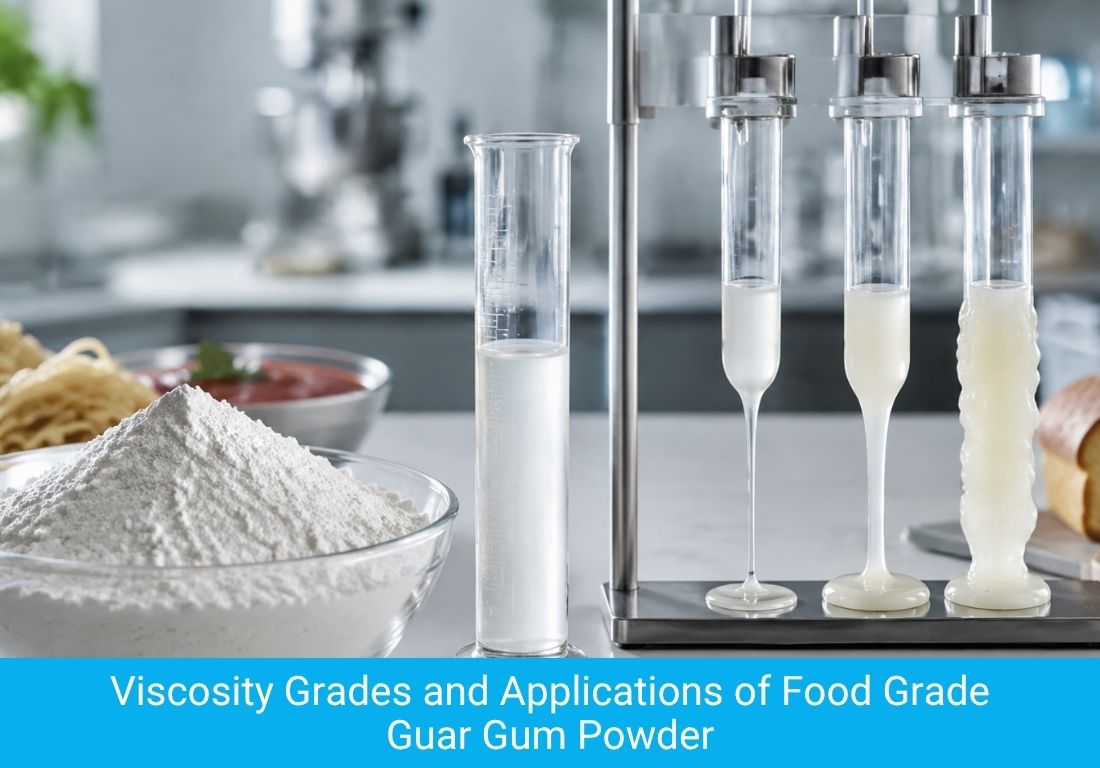
- 3000 to 4000 CPS: suitable for applications where moderate viscosity is needed, such as instant noodles, some beverage thickeners, and pet food. Lower viscosity grades hydrate more quickly and are easier to handle in cold water applications.
- 4500 to 5500 CPS: the mid-range grade used across the widest range of food applications including bakery, dairy, sauces, and dressings. This is the most commonly specified grade for general food manufacturing.
- 6000 to 7000 CPS: high-viscosity grade used where maximum thickening and water-binding performance is required, such as gluten-free formulations, low-fat products, and certain pharmaceutical food applications.
- Above 7000 CPS: very high viscosity grade used in specialised applications. Requires careful handling during formulation as overdosing creates stringy or gel-like textures that are difficult to correct.
Mesh Size in Food Grade Guar Gum Powder
Mesh size refers to the particle size of the guar gum powder and affects how quickly it hydrates in a food system. Finer mesh sizes hydrate more rapidly but may create dust handling challenges in production environments.
- 200 mesh: the standard for most food applications. Fine enough to hydrate uniformly in cold and hot water systems without leaving visible particles in the finished product.
- 300 mesh: ultra-fine grade used where very rapid hydration is critical, such as in cold-fill beverage applications or pharmaceutical formulations. Carries a premium over 200 mesh.
- 100 mesh: coarser grade used in some industrial food applications where slower hydration is acceptable or preferred.
Gum Content and Purity
Gum content refers to the galactomannan content of the powder, expressed as a percentage of total weight. Higher gum content means more functional thickening and stabilising material per kilogram of product:
- Standard food grade: gum content of 75 to 80 percent
- High-purity food grade: gum content of 82 to 85 percent, used in pharmaceutical applications and premium food formulations where maximum functionality per unit is required
- Gum content directly affects the usage rate required in a formulation and therefore the cost-in-use calculation that buyers should conduct when comparing products from different suppliers
Our Other Product
Kalonji Seed OilCertifications Required for Food Grade Guar Gum Powder
The certifications required for food grade guar gum powder vary depending on the target market and end application. Buyers should specify their certification requirements clearly when approaching suppliers.
E412 Designation: EU and UK Markets
Guar gum powder approved for food use in the European Union and the United Kingdom carries the designation E412 under the relevant food additive regulations. Suppliers serving these markets must:
- Provide a specification sheet confirming E412 compliance with the applicable food additive regulation
- Confirm compliance with maximum permitted levels for the specific food category in which the product will be used
- Provide pesticide residue testing results to the maximum residue levels specified in the relevant regulation
- Hold or have their manufacturing facility certified under a recognised food safety management standard
FDA GRAS Status: USA Market
In the United States, guar gum powder is classified as Generally Recognised As Safe (GRAS) by the Food and Drug Administration (FDA) for food use. Suppliers serving US buyers should:
- Confirm FDA GRAS status in their product documentation
- Ensure manufacturing facility compliance with US Food Safety Modernisation Act (FSMA) requirements for food ingredient suppliers exporting to the USA
- Provide full allergen, non-GMO, and country of origin declarations as required by US food labelling regulations
FSSAI Compliance: Indian Food Manufacturers
For food grade guar gum powder manufactured and sold within India, or exported from India with FSSAI-compliant documentation, the Food Safety and Standards Authority of India sets the applicable standards. FSSAI-compliant guar gum powder documentation should confirm:
- Compliance with FSSAI standards for food grade guar gum as a food additive
- Manufacturer's FSSAI licence number
- Testing in FSSAI-recognised or NABL-accredited laboratories
Halal Certification
Halal certification is mandatory for guar gum powder sold into predominantly Muslim markets including the GCC, Malaysia, Indonesia, North Africa, and the Levant region. It signals that the product has been manufactured, stored, and handled in compliance with Islamic dietary law. Key requirements for Halal-certified guar gum powder:
- Certification from a recognised Halal certifying body accepted in the target market
- No contact with non-Halal materials during processing or packaging
- Annual renewal of certification with inspection of the manufacturing facility
Kosher Certification
Kosher certification is relevant for buyers supplying Jewish consumer markets in North America, Europe, and Israel. While a smaller segment than Halal, Kosher certification commands a price premium and opens access to specialty retail and food service channels that require it. Requirements are similar in structure to Halal but governed by Jewish dietary law standards.
Organic Certification
Organic certified guar gum powder is available from suppliers who source from certified organic guar cultivation and process under certified organic manufacturing conditions. This certification is relevant for buyers supplying organic food brands in Europe, North America, and premium Asian markets. It carries a significant price premium over standard food grade product.
Read Our Article
Guar Gum Powder Application in Cheese ProcessingReading a Certificate of Analysis for Food Grade Guar Gum Powder
The Certificate of Analysis is the primary quality document for every batch of food grade guar gum powder. Buyers should review it carefully before accepting a shipment and should understand what each parameter means for their application.
Parameters Every Food Grade Guar Gum COA Must Include
- Appearance: description of colour and physical form, confirming the product matches specification
- Moisture content: expressed as percentage, should be below 12 percent for standard food grade
- Ash content: percentage of inorganic residue, should be below 1.5 percent for standard food grade
- Protein content: typically below 6 percent, higher protein indicates incomplete purification
- Gum content (galactomannan): should be above 75 percent for standard food grade
- Viscosity: measured in CPS at 1 percent concentration at 25 degrees Celsius, at 2 hours and 24 hours
- pH: typically 5.5 to 7.0 for a 1 percent solution
- Particle size: mesh size confirmation (200 mesh means 95 percent or above passes through a 200-mesh sieve)
- Heavy metals: lead below 2 PPM, arsenic below 3 PPM, mercury and cadmium within permitted limits
- Total plate count: below 10,000 colony-forming units per gram
- Yeast and mould: below 500 colony-forming units per gram
- Salmonella: absent in 25 grams
- coli: absent in 1 gram
- Batch number and date of manufacture: essential for traceability
- Shelf life: typically 24 months from date of manufacture when stored correctly
About Abdullabhai Abdul Kader (Ahmedabad)
Abdullabhai Abdul Kader (Ahmedabad) manufactures and exports food grade guar gum powder from Ahmedabad, Gujarat, India. The company supplies multiple grades to food manufacturers, pharmaceutical companies, and ingredient distributors across more than 30 countries, providing full certification and documentation as standard with every order.
What buyers receive from Abdullabhai Abdul Kader (Ahmedabad) on food grade guar gum powder:
- Multiple viscosity grades available: from 3000 CPS to 7200 CPS and above, in both 200 mesh and 300 mesh
- UNICOL product grades (2050, 2055, 2060, 2070) providing a clear and documented product range with published specifications
- E412 compliant food grade product with full EU and UK regulatory documentation
- FSSAI compliant manufacturing with batch-specific Certificate of Analysis for every shipment
- Halal certification available for buyers supplying Muslim-majority markets
- Non-GMO declaration, allergen declaration, and country of origin documentation included as standard
- Packaging in 25 kg HDPE paper-laminated bags with inner liner, shelf life of 24 months from production date
- Technical data sheets and MSDS available for all grades
- Responsive technical support for grade selection, formulation queries, and compliance documentation assistance
Abdullabhai Abdul Kader (Ahmedabad) understands that food grade guar gum powder procurement requires more than a competitive price. It requires consistent quality, complete documentation, and a supplier who understands what different markets and applications demand. Contact the team to request samples across multiple grades, receive full specification sheets, or discuss your certification and bulk supply requirements.
Food Grade Guar Gum Powder: Getting the Grade and Certification Right Protects Your Supply Chain
Buying food grade guar gum powder without a clear understanding of grades and certifications creates real commercial risk. A product that does not match your formulation requirements will affect production and product quality. A product that lacks the required market certification will create regulatory problems at import or retail. A supplier who cannot provide batch-specific documentation leaves you exposed in a food safety audit.
Getting these fundamentals right is not complicated once you know what to look for. Viscosity grade, mesh size, gum content, market-specific certification, and a complete batch Certificate of Analysis are the five non-negotiable elements of a compliant food grade guar gum powder procurement.
Abdullabhai Abdul Kader (Ahmedabad) delivers on all five. Contact the team today to start a conversation about your food grade guar gum powder requirements, request product samples across different grades, and receive the documentation package your market demands.

